

Table of contents
- What changed from API SP to API SQ
- Backward service coverage does not settle the application
- Match the API category to the correct ILSAC route
- Separate API licensing from a performance statement
- Build a controlled API SQ transition plan
- Approve documents and batch release before artwork
- Send an RFQ that keeps technical and commercial decisions aligned
- Frequently asked questions
- Sources
What changed from API SP to API SQ
API SP was introduced in 2020 for gasoline engines and strengthened protection against low-speed pre-ignition, timing-chain wear, turbocharger and piston deposits, sludge and varnish. API SQ was adopted for oils available in 2025 and keeps those core priorities while adding protection against low-speed pre-ignition after the oil has aged, improving timing-chain wear control and raising the category's high-temperature deposit and cleanliness expectations.
For an importer, the practical difference is not a single laboratory number. It is a revised performance system supported by engine tests, bench tests, formulation controls and licensing rules. A quotation that says API SQ should therefore identify the exact product, viscosity grade, claim level and evidence package rather than presenting SQ as a marketing suffix.
API 1509 states that oils meeting API SQ may be used where API SP and earlier S categories have been recommended. That creates useful backward service coverage, but it does not mean an SQ 0W-20 can replace an SP 5W-30 when the vehicle requires 5W-30. Category and viscosity remain separate selection decisions.
| Buyer question | API SP route | API SQ route | Evidence to request |
|---|---|---|---|
| Category generation | Introduced for 2020 gasoline-engine service | Adopted for 2025 gasoline-engine service | Current API category source and product claim register |
| Protection focus | LSPI, timing-chain wear, deposits, sludge and varnish | Adds aged-oil LSPI and improved chain-wear and deposit control | Test or licensing basis for the exact formulation |
| Earlier-category service | May cover SN and earlier where recommended | May cover SP and earlier where recommended | Vehicle requirement plus API 1509 service guidance |
| Viscosity choice | Follow the vehicle maker | Follow the vehicle maker | Owner manual and SAE grade on the proposed SKU |
Backward service coverage does not settle the application
Backward service language answers only one part of the buying question: whether a later API gasoline category can serve an earlier API category recommendation. It does not confirm that the product has the right viscosity, fuel-economy classification, emissions-system fit or mandatory vehicle-manufacturer approval for every application in the destination market.
Build the application matrix from current vehicle information. Record market, make, model, model year, engine, required SAE grade, API or ILSAC category and any manufacturer specification. Separate uncertain variants instead of relying on a catalogue phrase such as suitable for most modern cars. Hybrid, turbocharged and direct-injection vehicles can share an API category while requiring different viscosity grades or manufacturer standards.
Keep source dates beside the matrix. Service information, product licences and model coverage can change, while an old cross-reference may remain in a distributor's sales file for years. A dated evidence record lets the buyer distinguish a current selection from an inherited assumption.
Match the API category to the correct ILSAC route
API SQ and ILSAC GF-7 arrived together, but the labels are not interchangeable in every case. API's Motor Oil Guide explains that API SQ with Resource Conserving matches ILSAC GF-7A. GF-7A is the mainstream passenger-car route across eligible viscosity grades, while GF-7B applies only to SAE 0W-16 and uses the API Shield identification route.
The same guide identifies GF-6A and GF-6B as earlier categories and directs users toward GF-7A or GF-7B for the corresponding service. An importer planning a transition should keep GF-7A and GF-7B separate in the range file, artwork and application matrix. Do not place a GF-7B statement on a 0W-20 or 5W-30 product, and do not assume that an API SQ statement alone proves an ILSAC claim.
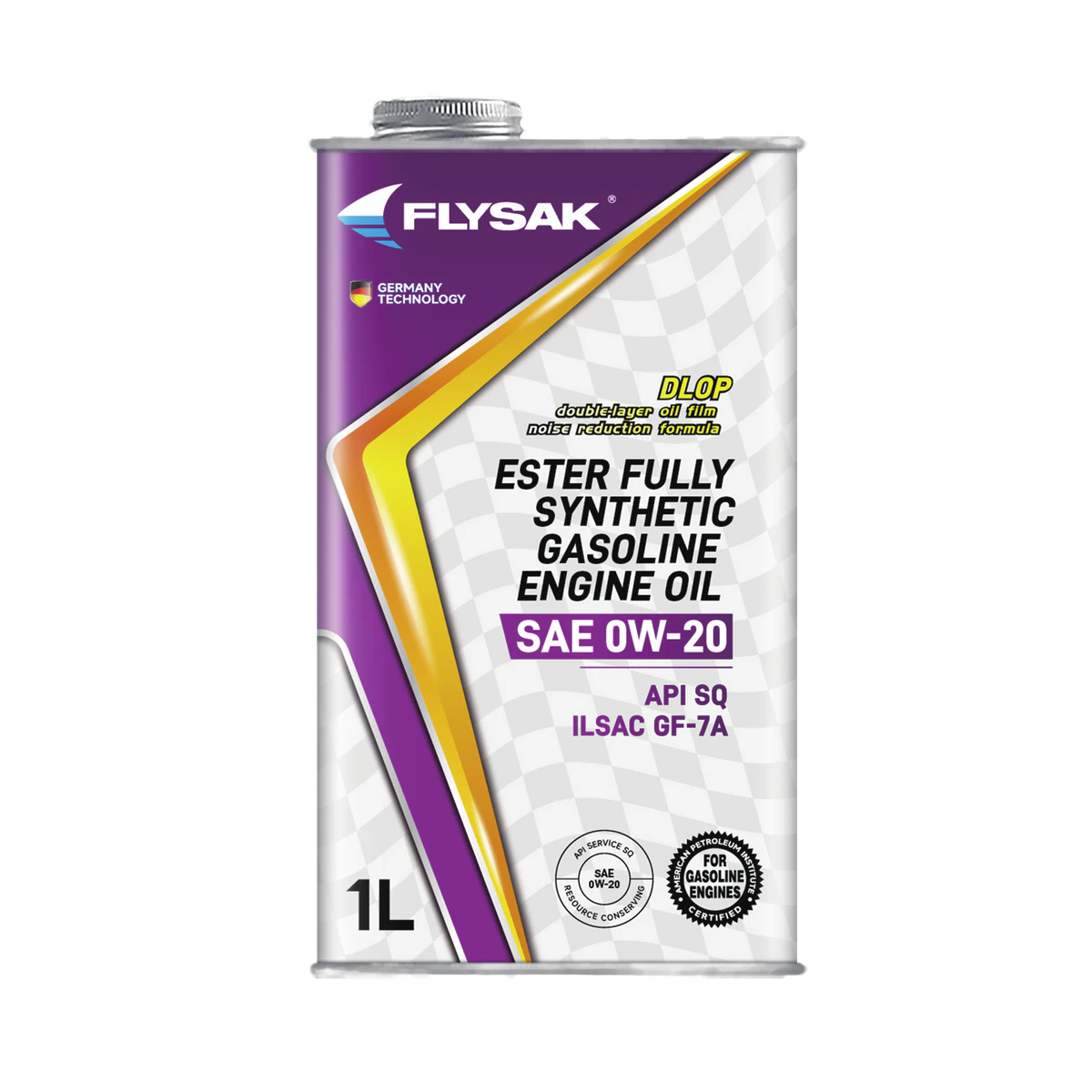
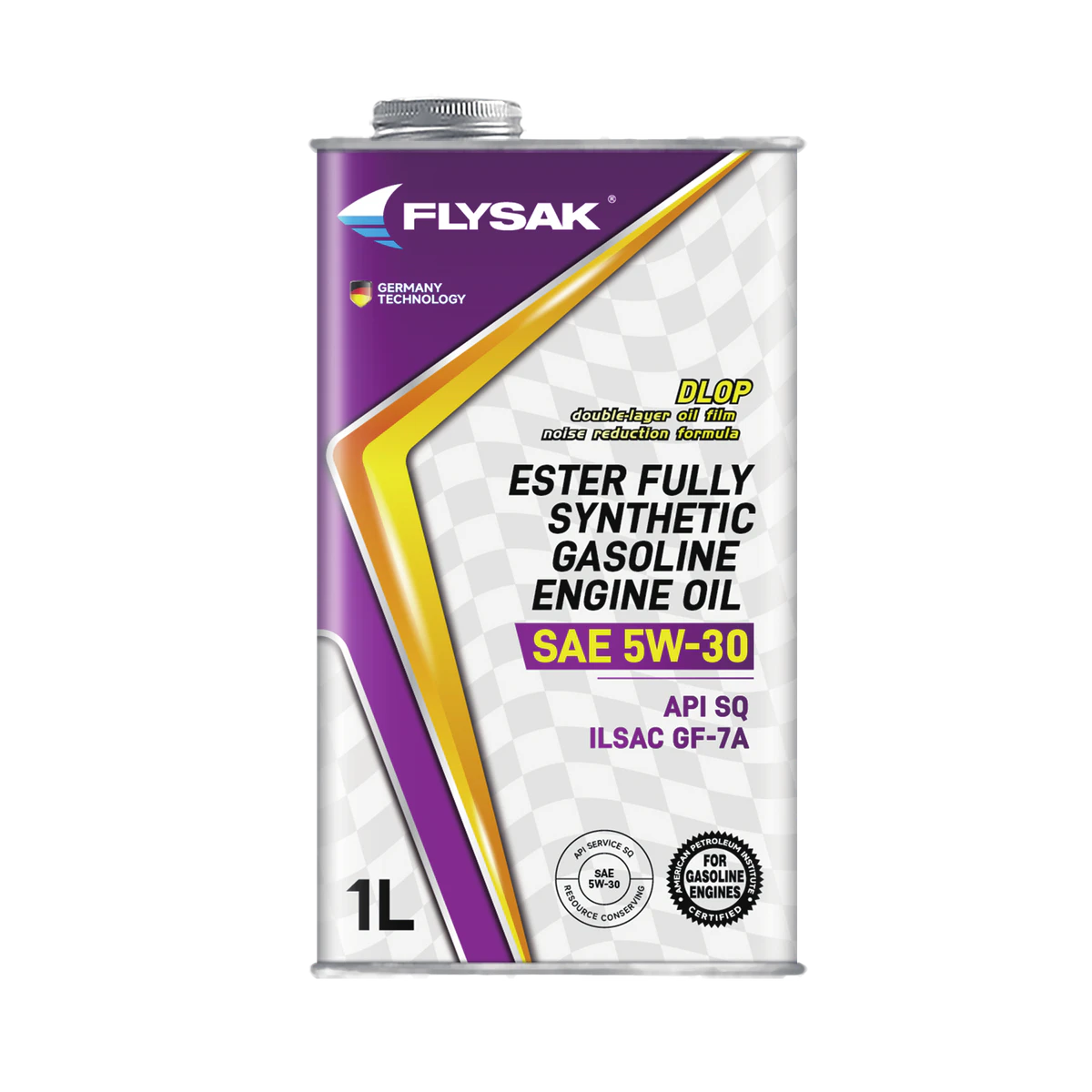
FLYSAK's current public engine-oil catalogue includes EO-021 SAE 0W-20 and EO-023 SAE 5W-30 products positioned to meet API SQ and ILSAC GF-7A. These two grades can support different confirmed demand, but neither should be presented as a universal substitute for all API SP oils or as GF-7B.
| Proposed label route | Viscosity boundary | Buyer check | Do not assume |
|---|---|---|---|
| API SQ | Use the stated SAE grade | Category evidence and exact vehicle requirement | That every SQ oil is Resource Conserving |
| API SQ Resource Conserving / GF-7A | Eligible GF-7A viscosity grade | Licence or documented claim for the exact product | That it satisfies a separate OEM approval |
| GF-7B / API Shield | SAE 0W-16 only | Exact 0W-16 product and mark eligibility | That GF-7B applies to 0W-20 or 5W-30 |
| API SP / GF-6A | Use the stated SAE grade | Current market demand and transition plan | That old artwork proves a current licence |
- Compare FLYSAK passenger-car engine oils — Review the current viscosity, API and ACEA product routes separately.
- Use the viscosity range-planning guide — Build the grade mix from vehicle demand rather than climate shorthand.
- Review the hybrid engine-oil supplier guide — Connect hybrid applications to viscosity, performance evidence and batch control.
Separate API licensing from a performance statement
API's Engine Oil Licensing and Certification System authorises eligible marketers to use the API Donut, Starburst and Shield marks. API also maintains a public directory that can be searched by licensee, brand, viscosity grade and service category. For procurement, that directory is stronger evidence than a logo in a quotation or a cropped package image.
Check the exact legal marketer, brand spelling, product name, SAE grade and category. A company can hold an API licence without every product or every private label being covered. A private-label project may also change the marketer of record and artwork responsibility. Ask the supplier to identify whose licence supports the finished brand and who controls renewals, product changes and traceability codes.
If a product is described only as positioned to meet, meets the performance level or suitable for API SQ applications, do not redesign that wording as API licensed or display an API quality mark without current authorisation. The label phrase must match the evidence level approved for the exact finished product.
- Follow the API licence verification checklist — Check licensee, brand, grade, category, directory status and artwork before ordering.
- Review EO-021 API SQ / GF-7A positioning — See the current 0W-20 product description and evidence boundaries.
- Review EO-023 API SQ / GF-7A positioning — Compare the current 5W-30 route for confirmed applications.
Build a controlled API SQ transition plan
A distributor rarely needs an overnight replacement of every API SP SKU. Start with vehicles that explicitly require or commercially benefit from the newer category, then identify earlier-category applications that the SQ product can serve in the correct viscosity. Keep specialist ACEA and OEM-approved products outside a blanket API transition when their separate requirements remain decisive.
Review existing stock, artwork, distributor registrations and customer commitments before setting a change date. Decide whether SP and SQ products will overlap, which labels need revision, how sales teams will explain the change and how returns or complaints will be traced. Avoid promising a universal upgrade if the new product does not preserve every viscosity or approval route in the old range.
The commercial comparison should use like-for-like scope: product and claim, pack and carton, document set, sample plan, batch release, change control and loading plan. Price per litre is not comparable if one offer includes a licensed finished brand and another offers only a performance-level claim.
| Control point | Evidence before approval | Buyer decision |
|---|---|---|
| Application map | Vehicle, engine, viscosity and category source | Approve covered and excluded applications |
| Claim status | Directory record, licence evidence or written performance basis | Approve exact label wording and marks |
| Technical file | Current TDS, SDS, written specification and sample COA | Confirm one formulation identity |
| Finished pack | Filled sample, seal, label, trace code and carton | Approve artwork and physical pack together |
| Transition stock | SP inventory, sales forecast and change date | Set overlap and customer communication rules |
| Change control | Notification triggers and reapproval process | Define when evidence or artwork must be reviewed again |
Approve documents and batch release before artwork
Request the current Technical Data Sheet, Safety Data Sheet, written finished-product specification and a representative Certificate of Analysis format for each proposed SKU. The specification should identify controlled properties, methods and acceptance limits; typical values alone are not batch-release limits.
Connect every document to the same product code and formulation revision. If the private label uses a different brand name, confirm how that name maps to the technical file and any licensing record. The batch code on the bottle and carton should link to blending, filling and packaging records so a market complaint can be investigated without guessing which formulation was supplied.
Approve the filled pack, not artwork in isolation. Check mark placement, category and viscosity wording, language, trace code, barcode ownership, label adhesion, seal, carton and destination-market information. API branding requirements and local label rules should be reviewed before printing production quantities.
Send an RFQ that keeps technical and commercial decisions aligned
List destination markets, target vehicle groups, required SAE grades, API and ILSAC routes, any separate OEM or ACEA specifications, pack sizes, label languages, expected volume by SKU and sales channels. Mark unresolved applications instead of asking the supplier to confirm a universal fit.
Ask each supplier to return an application map, claim classification, licence or test basis, current documents, sample plan, finished-pack options, batch-release proposal and change-control terms. Then compare commercial terms only after the technical scope is aligned. Packaging minimums, mixed-SKU options, trade terms and production timing should remain subject to the final written quotation.
FLYSAK can review confirmed API SQ, API SP and viscosity demand against its current passenger-car engine-oil catalogue and prepare a private-label proposal. Final product selection, claims, documents, packaging and commercial terms depend on the written project scope.
- Plan private-label engine-oil artwork — Coordinate formula, documents, pack and label approval in one project.
- Send your engine-oil sourcing brief — Share target vehicles, grades, category routes, packs and order plan for review.
Frequently asked questions
What is the main difference between API SQ and API SP?
API SQ is the 2025 gasoline-engine category. It builds on API SP protection and adds requirements including aged-oil LSPI protection, improved timing-chain wear control and revised high-temperature deposit performance. Compare the exact product evidence rather than treating the category letters as a complete specification.
Can API SQ be used where API SP is required?
API 1509 states that API SQ oils may be used where API SP and earlier S categories are recommended. The vehicle's required SAE viscosity and any ILSAC or manufacturer specification still apply.
Can API SP be used where API SQ is required?
Do not assume so. If current vehicle information requires API SQ, select a product supported for SQ in the correct viscosity and with any other required specification.
Is API SQ the same as ILSAC GF-7A?
Not automatically. API SQ with Resource Conserving matches the GF-7A route, but an API SQ statement alone does not prove every ILSAC claim. Verify the exact category, mark and product evidence.
What is the difference between GF-7A and GF-7B?
GF-7A is the mainstream passenger-car route across eligible viscosity grades. GF-7B applies only to SAE 0W-16 and uses the API Shield identification route. Do not apply GF-7B wording to 0W-20 or 5W-30 products.
How can an importer verify an API SQ licence?
Search API's EOLCS directory and match the legal licensee, brand, product or viscosity grade and service category. Confirm that the finished private label is within the recorded scope before approving API marks.
What documents should be requested for an API SQ private-label order?
Request the current TDS, SDS, written product specification, claim or licence evidence, application matrix, sample COA, filled-pack proof and change-control procedure. All records should identify the same proposed formulation and finished brand.
Sources
Technical and regulatory references reviewed for this article:
- API 1509, 23rd Edition — Engine Oil Licensing and Certification System — Reviewed for the API SQ and API SP service-category definitions, category introduction dates, backward-service guidance and API mark rules.
- American Petroleum Institute — Motor Oil Guide — Reviewed for the current SQ, SP, GF-7A, GF-7B, GF-6A and GF-6B service descriptions and the relationship between API SQ Resource Conserving and ILSAC GF-7A.
- American Petroleum Institute — Engine Oil Licensing and Certification System — Reviewed for EOLCS licensing, monitoring, marketplace audit, traceability and enforcement context.
- American Petroleum Institute — Certification Directories — Reviewed for the public EOLCS directory fields importers can use to verify licensees, brands, viscosity grades and API service categories.
- American Petroleum Institute — EOLCS Application and Fees — Reviewed for the requirement that marketers obtain authorisation before using API Engine Oil Quality Marks or describing a product as API licensed.