

Table of contents
- Start with the marketer named on the finished container
- Search the API EOLCS Directory in a reproducible way
- Match the exact product instead of accepting a company-level claim
- Read the Donut, Starburst and Shield correctly
- Keep SAE viscosity, API performance and vehicle fitment separate
- Resolve the private-label licensing structure before artwork
- Connect the license check to documents and batch traceability
- Send an RFQ that makes license gaps visible early
- Frequently asked questions
- Sources
Start with the marketer named on the finished container
API 1509 defines the oil marketer as the organization responsible for the integrity of the brand name and the way the branded product is represented in the marketplace. That point matters in contract manufacturing. The blender, packer, exporter, brand owner and importer may be different companies, but the license check must follow the marketer and brand that will actually appear on the finished container.
Ask the supplier to state the legal marketer name, API license number, proposed brand name and the exact company name that will appear on the front or back label. Compare those details with the official API record before discussing use of the API Marks. A certificate image or screenshot can support the file, but the live API directory should be the controlling public check because its status can change.
If the proposed structure changes—for example, from the manufacturer's brand to the importer's private label—repeat the review. API 1509 treats a difference in brand name, viscosity grade or service category as a separate engine oil for licensing purposes. Do not assume that one licensed house brand automatically covers an unrelated buyer-owned name.
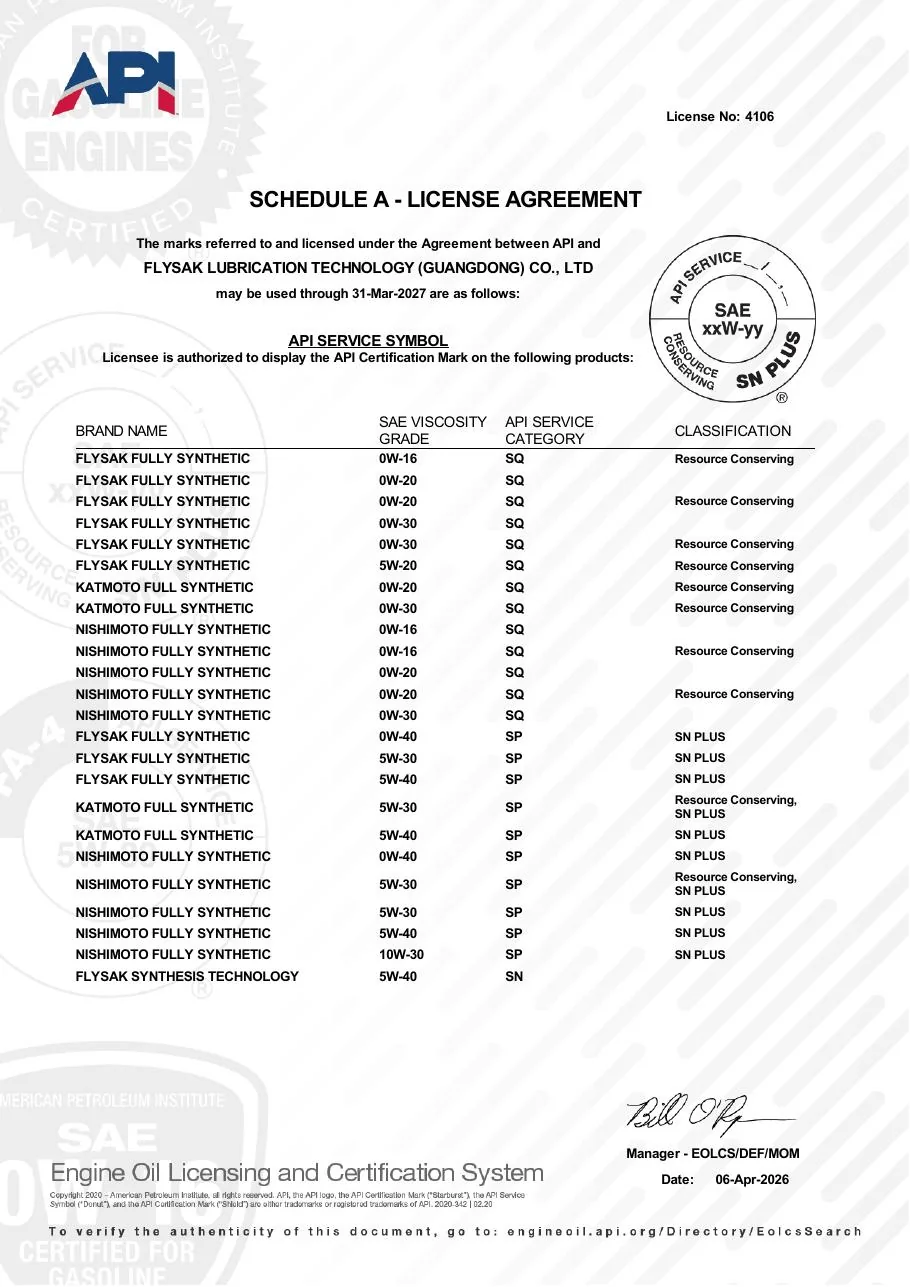
- Review FLYSAK factory and certification evidence — Use the current evidence page as a starting point, then verify time-sensitive license details in the official directory.
Search the API EOLCS Directory in a reproducible way
API Publication 1520 points buyers to the online EOLCS Directory, which includes active licensees and their licensed products. The directory can be searched by company name, license number, brand, SAE viscosity grade, API service category, ILSAC specification, country and other fields. Save the search criteria and review date in the sourcing file so another team member can repeat the check.
Begin with the legal company name or four-digit license number supplied by the vendor. Open the company record rather than stopping at the search result. Then filter the product list by brand, viscosity and category. If spelling, punctuation or company identity differs from the label proof, ask for an explanation before approving artwork.
A zero-result search is not proof of fraud; it may reflect a spelling difference, a different marketer name or an incomplete proposal. It is, however, a reason to pause use of API trademark artwork until the supplier provides a record that can be independently reproduced.
| Directory field | What to match | Buyer decision |
|---|---|---|
| Company name and license number | Legal marketer shown in the live record | Confirm the correct licensee before reviewing products |
| Brand name | Exact brand proposed on the finished label | Do not transfer coverage from another house brand |
| SAE viscosity grade | Exact grade for each quoted SKU | Treat each viscosity as a separate check |
| API service category | SQ, SP or other category stated for the product | Approve only the category shown for that listed oil |
| ILSAC specification or classification | GF-7A, GF-7B or other applicable listing | Match the proposed certification mark and vehicle requirement |
| Review date | Date and source URL recorded by procurement | Recheck before final artwork and shipment |
Match the exact product instead of accepting a company-level claim
A supplier may legitimately hold an API license while also selling products that are not covered by the same category or mark. API 1509 requires product-specific information based on the final formulation, and it notes that a different viscosity grade, service category or brand name denotes a separate engine oil. The purchasing question is therefore not simply whether the company is licensed, but whether this product is licensed in this form.
Build one line in the approval matrix for every proposed SKU. Record the commercial product name, brand, SAE grade, API category, ILSAC classification where applicable, marketer, license number and directory review date. Compare that line with the TDS and label proof. If the quotation uses a family name while the directory uses individual products, require a clear written cross-reference.
FLYSAK's current passenger-car catalogue includes API SQ engine oils across several viscosities and performance routes. Buyers should still request the current product documents and applicable license evidence for the exact SKU they plan to order; a catalogue heading is not a substitute for the live product-level check.
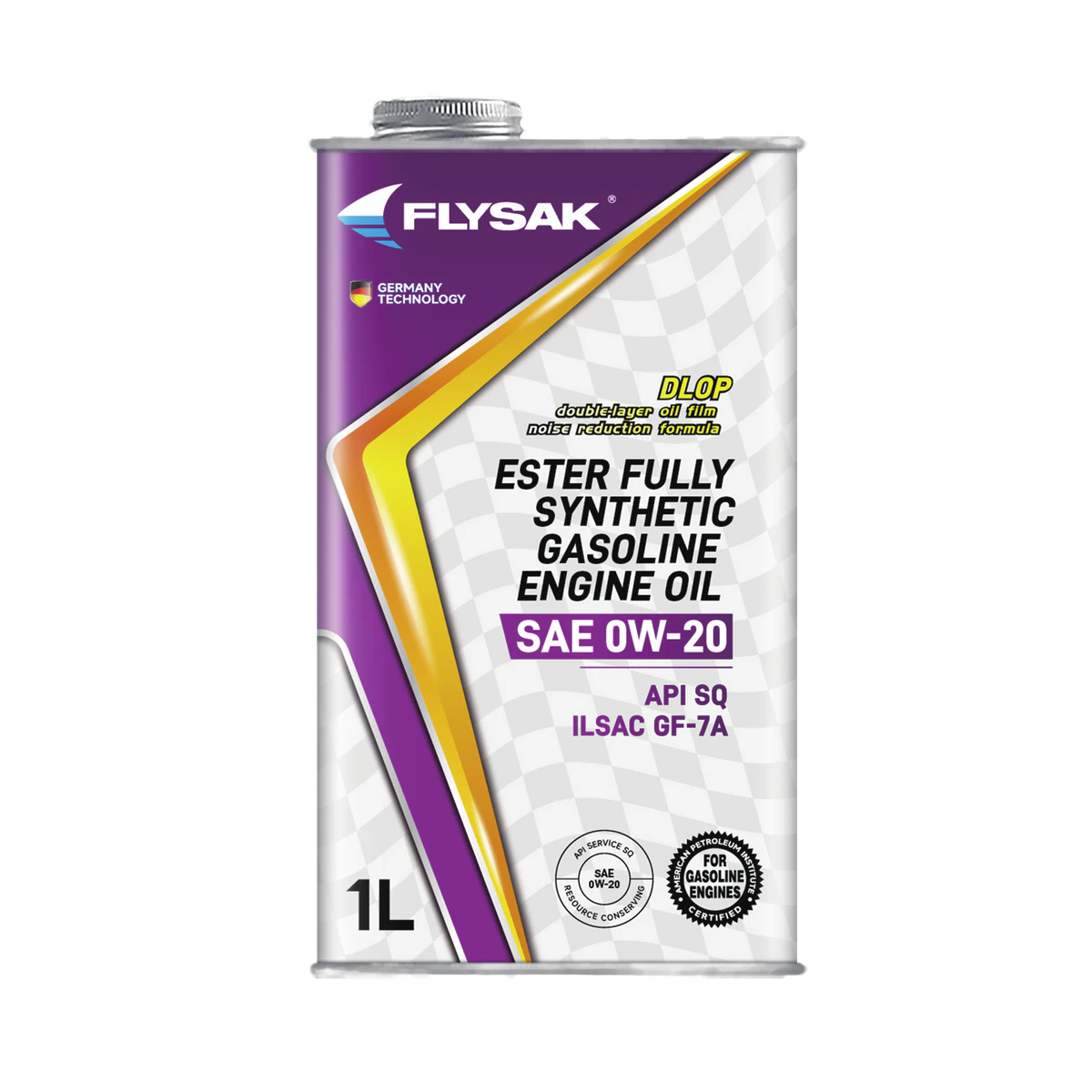
- Compare the FLYSAK passenger-car engine oil catalogue — Review current viscosities, performance statements and pictured pack references.
- Review FLYSAK EO-021 SAE 0W-20 — Check the stated API SQ and ILSAC GF-7A route and request current documents.
Read the Donut, Starburst and Shield correctly
The API Motor Oil Guide distinguishes the API Service Symbol, commonly called the Donut, from the API Certification Marks known as the Starburst and Shield. The Donut shows the service category in the upper portion and the SAE viscosity grade in the centre, with an eligible additional classification in the lower portion. It should be read as structured information, not as a decorative badge.
For current passenger-car gasoline oils, the Starburst identifies oils meeting the applicable ILSAC GF-7A route, while the Shield identifies GF-7B oils. The current API guide states that the Shield applies to SAE 0W-16, and that the Starburst cannot be applied to 0W-16. That distinction gives artwork reviewers a quick reasonableness check, but the official directory remains necessary.
Request a high-resolution front and back label proof and compare the mark, words, category and viscosity with the licensed product record. Do not redraw, translate inside or alter an API mark for visual style. The final printer file should be approved only after the product and mark route agree.
| API mark | Information represented | Importer check |
|---|---|---|
| Service Symbol “Donut” | API service category, SAE grade and eligible lower classification | Match every field with the listed product and label proof |
| Certification Mark “Starburst” | Current ILSAC GF-7A route for eligible passenger-car oils | Confirm product eligibility and directory listing |
| Certification Mark “Shield” | Current ILSAC GF-7B route for SAE 0W-16 | Reject a mismatched viscosity or unsupported mark |
| Supplier-created icon or text | Marketing statement only | Do not treat it as an API license or trademark authorization |
Keep SAE viscosity, API performance and vehicle fitment separate
SAE J300 defines engine-oil viscosity grades in rheological terms; it does not include other oil characteristics. In practical procurement, SAE 0W-20 or 5W-30 describes viscosity behaviour, while API SQ or ILSAC GF-7A describes a performance route. An OEM specification or owner-manual requirement adds another application layer. None of these fields should be used as a shortcut for the others.
For each destination market, map important vehicles to the required viscosity, API or ILSAC category and any mandatory OEM approval. Then compare the supplier's licensed-product list with that matrix. A valid API SQ 5W-30 oil is not automatically the correct choice for a vehicle calling for a different viscosity or a separate manufacturer approval.
When one brand contains several viscosities, review each product separately and make the grade prominent in artwork, carton markings and warehouse coding. Similar-looking bottles can create picking and workshop errors even when every formulation is technically sound.
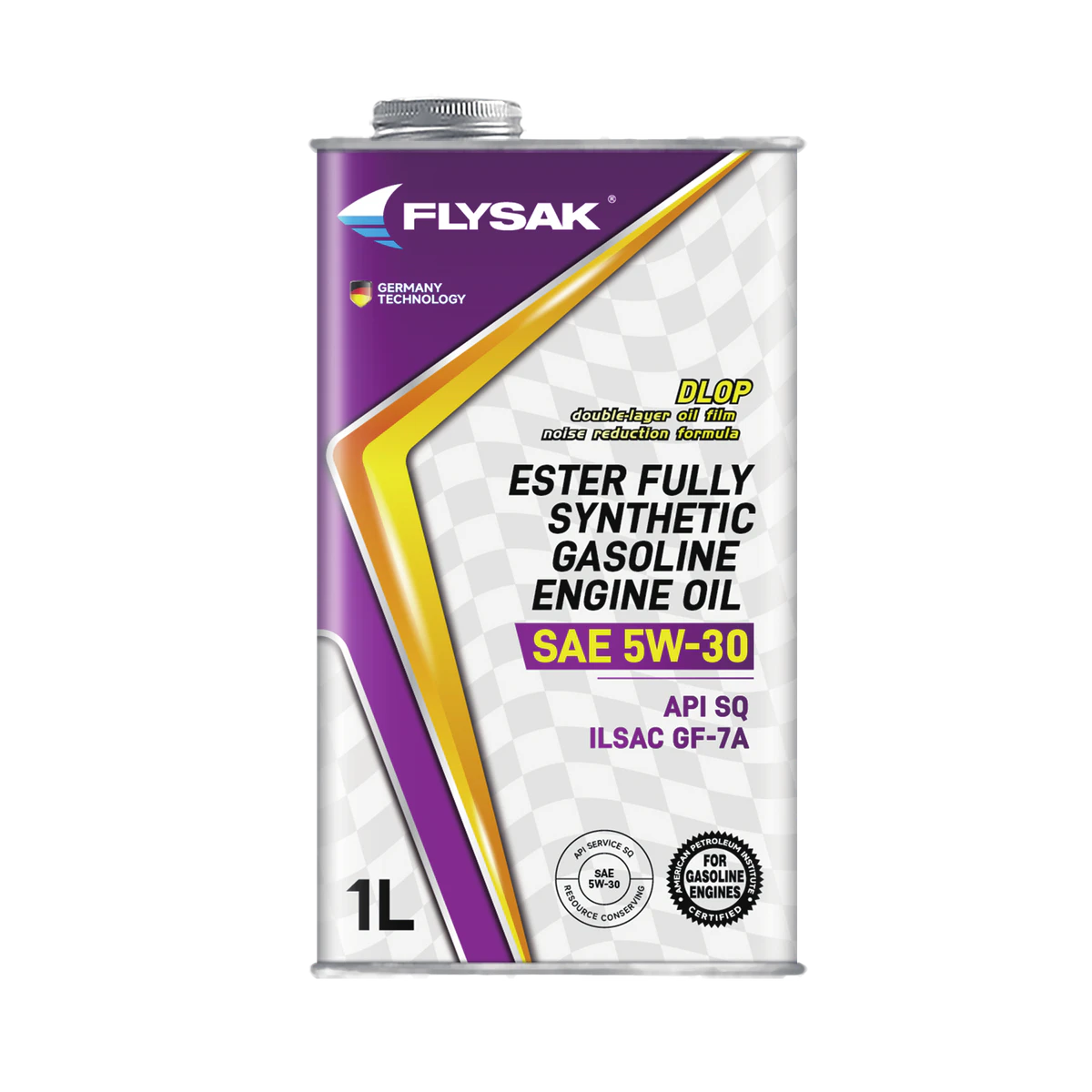
- Review FLYSAK EO-023 SAE 5W-30 — Compare another viscosity under the current passenger-car range.
- Read the hybrid engine oil supplier guide — See how vehicle requirements, viscosity and performance categories are separated for hybrid ranges.
Resolve the private-label licensing structure before artwork
Private label changes the brand and often changes the marketer named on the package. API 1509 clarifies that the marketer is responsible for the brand's integrity and representation, and its licensing clarifications address oils resold under another company's name. Importers should not assume that permission to buy a licensed formulation also grants permission to place API Marks on a new brand.
Ask the supplier to map the proposed arrangement in writing: legal marketer, brand owner, manufacturer or packer, API licensee, licensed brand and licensed product. Confirm what must be completed before the API Marks can appear on the buyer's label. Keep unlicensed draft artwork free of API trademark claims until the applicable route is confirmed.
The same review applies when changing suppliers. If the brand name remains the same but formulation, manufacturer, marketer or license route changes, require updated evidence and artwork approval rather than carrying the previous supplier's license assumptions into the new order.
- Review FLYSAK private-label support — Organise the product, packaging and document discussion around the confirmed programme.
- Compare a replacement or second-supplier route — Use current specifications and evidence when moving an existing brand.
Connect the license check to documents and batch traceability
The public directory answers an important question, but it does not replace the supplier document pack. Request a current TDS, SDS, written product specification, applicable license evidence, representative performance support, sample batch COA and approved front and back labels. The product names and viscosity grades should agree across those records.
API's monitoring programme checks packaged and bulk oils and also examines package marking and product trace codes. For the importer, the practical control is a legible batch or date code that connects the shipped pack to production and release records. Agree the code format, sample COA and retained-sample process before the first commercial order.
Define change control as part of the supply agreement. A change in formulation, brand name, viscosity grade, service category, marketer, label, packer or license status may require a fresh review. Advance notice protects the importer from continuing to print or distribute claims that no longer match the approved route.
| Evidence | Purpose | Approval point |
|---|---|---|
| Live EOLCS directory record | Confirms current licensee and listed product details | Archive the review date and repeat before shipment |
| TDS and written specification | Connects viscosity, category, typical properties and product name | Match the exact quoted SKU |
| Front and back label proof | Shows marketer, brand, API mark, grade and claims | Approve only after the license route is confirmed |
| Sample COA | Shows proposed routine batch-release checks | Agree limits and release responsibility |
| Batch or date-code plan | Links market samples to production records | Verify legibility on the filled sample |
| Change-control procedure | Defines notice and reapproval triggers | Include before the first purchase order |
Send an RFQ that makes license gaps visible early
A useful RFQ lists the destination countries, vehicle groups, viscosity grades, required API or ILSAC categories, any OEM specifications, proposed brand name, marketer name, pack sizes, label languages and first-order mix. Ask the supplier to return the license number, directory cross-reference, proposed SKU matrix, document list, finished-sample plan and any unsupported items.
Review the technical and licensing route before negotiating around a printed-bottle minimum. Otherwise, a buyer can approve a large quantity of labels or cartons before learning that the proposed brand, category or mark needs a different route. Commercial terms should be compared only after the product and artwork basis is clear.
FLYSAK can organise a passenger-car engine oil proposal around its current catalogue, private-label packaging process and available product documents. Importers should provide the target market, brand structure, vehicle requirements, grades and order plan, then verify the applicable API evidence before approving artwork or ordering printed packaging.
- Send your engine oil sourcing brief — Share the market, brand structure, required grades, specifications, pack sizes and first-order plan.
Frequently asked questions
Does an API-listed company mean every engine oil it sells is licensed?
No. Open the company's EOLCS record and verify the exact brand, product, SAE viscosity grade and API or ILSAC category proposed in the quotation. A company-level license should not be transferred to unlisted products or unrelated brands.
How can an importer verify an API engine oil license?
Search the official API EOLCS Directory by legal company name or four-digit license number, open the licensee record, and match the proposed brand, product, viscosity and category. Save the review date and repeat the check before final artwork and shipment.
Is API SQ the same as ILSAC GF-7A?
They are connected but should not be treated as identical labels in every context. API's current guide explains that API SQ with Resource Conserving matches the ILSAC GF-7A performance route. Confirm the exact product listing and mark eligibility rather than combining the terms loosely.
Can the API Starburst be used on SAE 0W-16 oil?
The current API Motor Oil Guide states that the Starburst cannot be applied to SAE 0W-16. The Shield identifies current ILSAC GF-7B oils and applies to SAE 0W-16. The product must still be properly licensed and listed.
Does an API license prove an OEM approval?
No. API licensing covers the applicable API or ILSAC performance and mark route. A vehicle-manufacturer approval or specification is a separate evidence path. Follow the owner's manual and verify any mandatory OEM approval independently.
Can a private-label buyer use the manufacturer's API license on a new brand?
Do not assume so. Confirm the marketer and brand that will appear on the container, the applicable EOLCS listing and the licensing steps required for that private-label structure before using API Marks in artwork.
Which documents should accompany the API directory check?
Request the current TDS, SDS, written specification, applicable license evidence, product or brand cross-reference, front and back label proof, sample COA, batch-code plan and change-control procedure. All documents should trace to the exact proposed SKU.
Sources
Technical and regulatory references reviewed for this article:
- API 1509, Engine Oil Licensing and Certification System, 24th Edition, July 2026 — Reviewed for marketer responsibility, product-specific licensing, API Marks, label use and product traceability.
- API Engine Oil Licensing and Certification System overview — Reviewed for the voluntary EOLCS programme, monitoring, marketplace testing and enforcement framework.
- API Publication 1520 and EOLCS Licensee Directory — Reviewed for the live licensee and licensed-product search fields available to buyers.
- API Motor Oil Guide, April 2025 — Reviewed for API SQ, ILSAC GF-7A/GF-7B and the Donut, Starburst and Shield explanations.
- SAE J300_202405 Engine Oil Viscosity Classification — Reviewed for the scope and limits of SAE engine-oil viscosity classification.