
Table of contents
- Why coolant colour cannot establish compatibility
- Start with the vehicle requirement, not a colour chart
- Separate chemistry, concentration and application
- Ask what each test and document actually proves
- Use the FLYSAK coolant range as a shortlist
- Control colour and artwork after the product is approved
- Make receiving and change control part of the purchase
- Send an RFQ that exposes compatibility gaps
- Frequently asked questions
- Sources
Why coolant colour cannot establish compatibility
There is no global rule that assigns one coolant chemistry or vehicle specification to each colour. Dye choices can be influenced by a vehicle manufacturer, coolant marketer, market convention or brand architecture. BASF's GLYSANTIN guidance states directly that colour alone cannot identify a coolant's chemical and technical properties.
That distinction matters at the buying desk. A red, green, blue, amber or pink sample may look familiar without matching the required inhibitor system, glycol base, concentration or vehicle-manufacturer specification. Colour can also change during service without automatically proving that a fluid has failed; Ford owner information, for example, notes that an otherwise clear and uncontaminated coolant may shift in colour during normal operation.
Use colour after the technical match is complete: to distinguish approved SKUs, support warehouse picking and help workshops recognise a product. Do not use it to create a compatibility statement or approve a substitute.
| Question | Colour can help with | Evidence still required |
|---|---|---|
| Which SKU is this? | Visual identification within one controlled range | Product code, label revision and batch code |
| Is the chemistry correct? | Nothing conclusive | Current TDS, written formulation description and supplier confirmation |
| Does it fit the vehicle? | Nothing conclusive | Owner or service information and manufacturer specification |
| Can two coolants be mixed? | Nothing conclusive | Manufacturer mixing instruction and documented compatibility |
| Has used coolant failed? | A change may prompt inspection | Condition, contamination, service history and approved diagnostic procedure |
Start with the vehicle requirement, not a colour chart
Build the application list before asking suppliers for samples. Record destination market, make, model, model year, engine or powertrain and the exact coolant specification stated in current owner or service information. Similar vehicles can use different requirements across years, engines and regions, so a broad make-only claim is not enough.
Keep the source and review date beside every application. If a manual calls for a manufacturer specification, record that identifier exactly and note whether the supplier is presenting an approval, an official listing, a test-supported claim or a recommendation. Those evidence levels are not interchangeable.
Ford's guidance instructs owners to use coolant meeting the stated Ford specification and warns against mixing different coolant colours or types. The purchasing lesson is wider than one brand: retain the exact vehicle requirement rather than replacing it with a generic colour family.
| Field | Buyer evidence | Release rule |
|---|---|---|
| Vehicle identity | Market, model year, engine or powertrain | Separate uncertain variants |
| Required coolant | Current owner or service source | Copy the specification exactly |
| Supplier product | Controlled product and formulation code | One identity across sample, documents and label |
| Claim basis | Approval, listing, test report or written recommendation | Use wording that matches the evidence level |
| Mixing rule | Manufacturer instruction for drain, refill or top-up | Do not infer from colour |
| Review status | Source date, reviewer and exclusions | Recheck before artwork or range expansion |
Separate chemistry, concentration and application
Coolant families are often described with terms such as inorganic, organic-acid or hybrid inhibitor technology. These descriptions can help organise a supplier discussion, but the acronym or family name is not a universal vehicle approval. Suppliers can use different additive designs, dosages and marketing terms within a broad family.
Also record whether the product is a concentrate or ready-to-use fluid. Concentrate needs a documented water quality and mixing plan; ready mix is supplied at a defined concentration and should not be diluted unless the manufacturer instructs otherwise. The product form affects freeze protection, packaging, landed cost, workshop instructions and label wording, but it still does not replace the vehicle specification.
ASTM D3306 covers defined glycol-base coolant types for automobiles and light-duty service, including concentrates and prediluted products. Conformance to an industry specification can be useful evidence, yet it does not automatically demonstrate every vehicle-manufacturer approval or prove compatibility with coolant already in the system.
- Compare premixed coolant and concentrate — Review water quality, packaging and landed-cost controls for each supply form.
Ask what each test and document actually proves
A technical data sheet should identify the product, intended use, form and representative properties. The safety data sheet addresses classification, handling and transport information for the exact formulation. A batch certificate of analysis reports agreed checks for a particular production batch. None of these documents should be borrowed from another colour or a similar product name.
For performance evidence, ask for the standard edition, test method, sample identity, concentration, laboratory, date, result and acceptance criterion. ASTM maintains separate methods for properties such as freezing point, equilibrium boiling point and controlled glassware corrosion. A single freeze-point result does not establish corrosion performance, and a pH or density check does not replace a complete performance specification.
Agree which items appear on the routine COA and which belong to formulation qualification or periodic verification. The quotation should state the exact product and evidence package rather than promise an undefined list of ASTM tests.
| Record | What it supports | Important boundary |
|---|---|---|
| TDS | Product identity, intended use and representative properties | Typical values are not automatically batch limits |
| SDS | Hazard classification, handling and transport information | Must match the exact formulation and destination needs |
| Batch COA | Agreed release checks for a named batch | Only proves the reported items and batch |
| ASTM D1177 result | Freezing point by the stated method | Does not alone prove vehicle compatibility |
| ASTM D1120 result | Equilibrium boiling point under the method conditions | Does not replace pressurised-system or OEM requirements |
| ASTM D1384 result | Controlled corrosion effect on specified metal specimens | One method within a wider qualification programme |
Use the FLYSAK coolant range as a shortlist
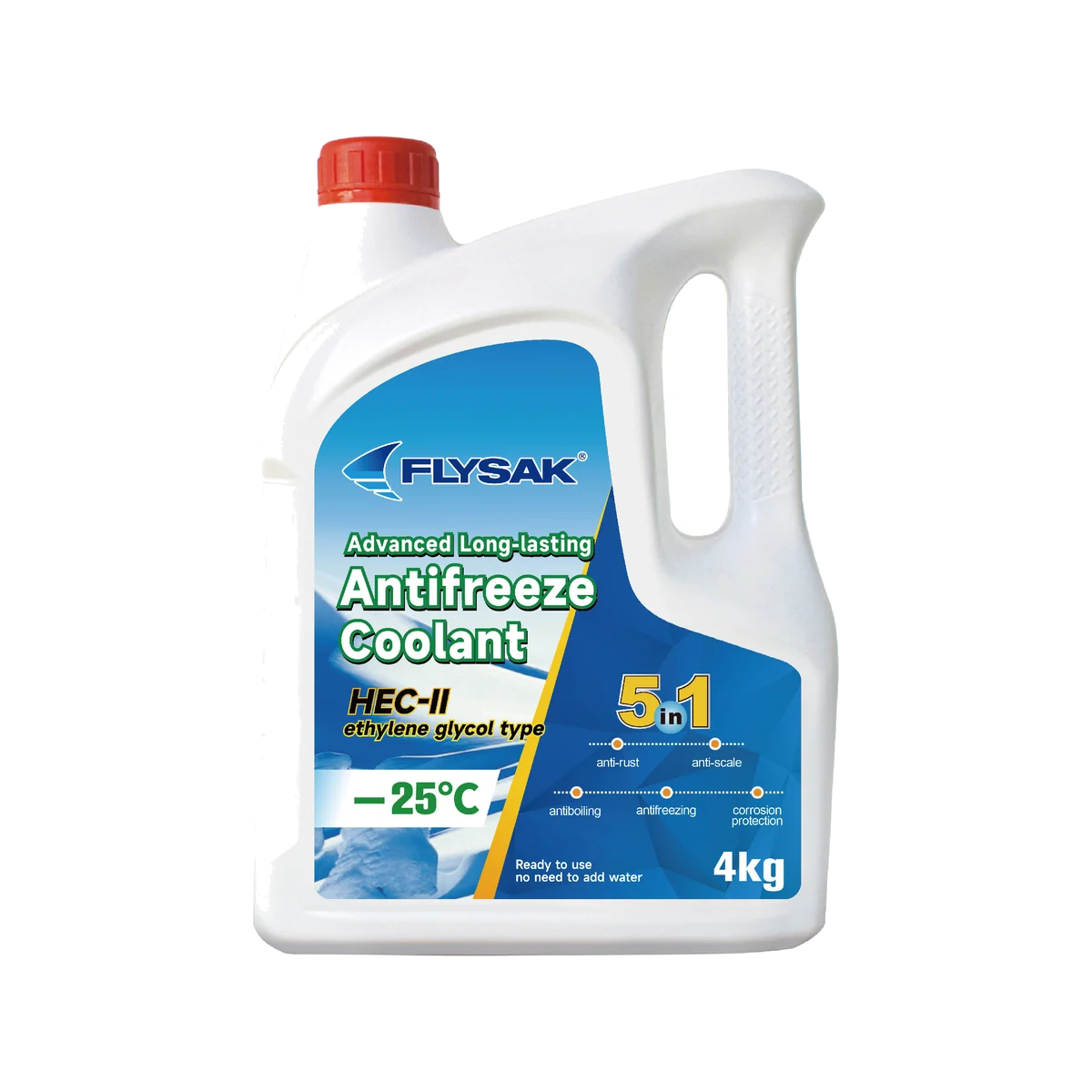
FLYSAK's current public catalogue lists two four-litre ready-to-use ethylene-glycol coolant routes for passenger-car and light-vehicle cooling systems: AC-001 with a stated minus 25 degrees Celsius freeze-protection profile and AC-003 with a stated minus 45 degrees Celsius long-life organic-acid inhibitor profile. These are catalogue starting points, not universal replacements selected by bottle or fluid colour.
For either route, request the current TDS, SDS, written product specification, batch COA format and compatibility statement for the intended vehicles. Confirm whether the quoted formulation, pictured pack, sample and final artwork all carry the same product code before approving a purchase order.
- Review the FLYSAK coolant catalogue — Compare the two current ready-to-use product routes.
- Review FLYSAK AC-001 coolant — See the current minus 25 degrees Celsius product and pack reference.
- Review FLYSAK AC-003 long-life coolant — See the current minus 45 degrees Celsius product and carton reference.
Control colour and artwork after the product is approved
In a private-label programme, freeze the technical product before the design team treats colour as a branding decision. The brief should connect the formulation code, coolant appearance, bottle and cap, label version, specification wording, concentration, freeze-protection statement, languages, responsible-party information and batch-code position.
If one market associates a colour with a familiar coolant family, do not let that convention create an unsupported compatibility claim. A label can state the verified product type and application evidence while using colour for brand recognition. Avoid universal statements such as suitable for all red coolants or mixes with any green coolant unless current, product-specific evidence genuinely supports the wording.
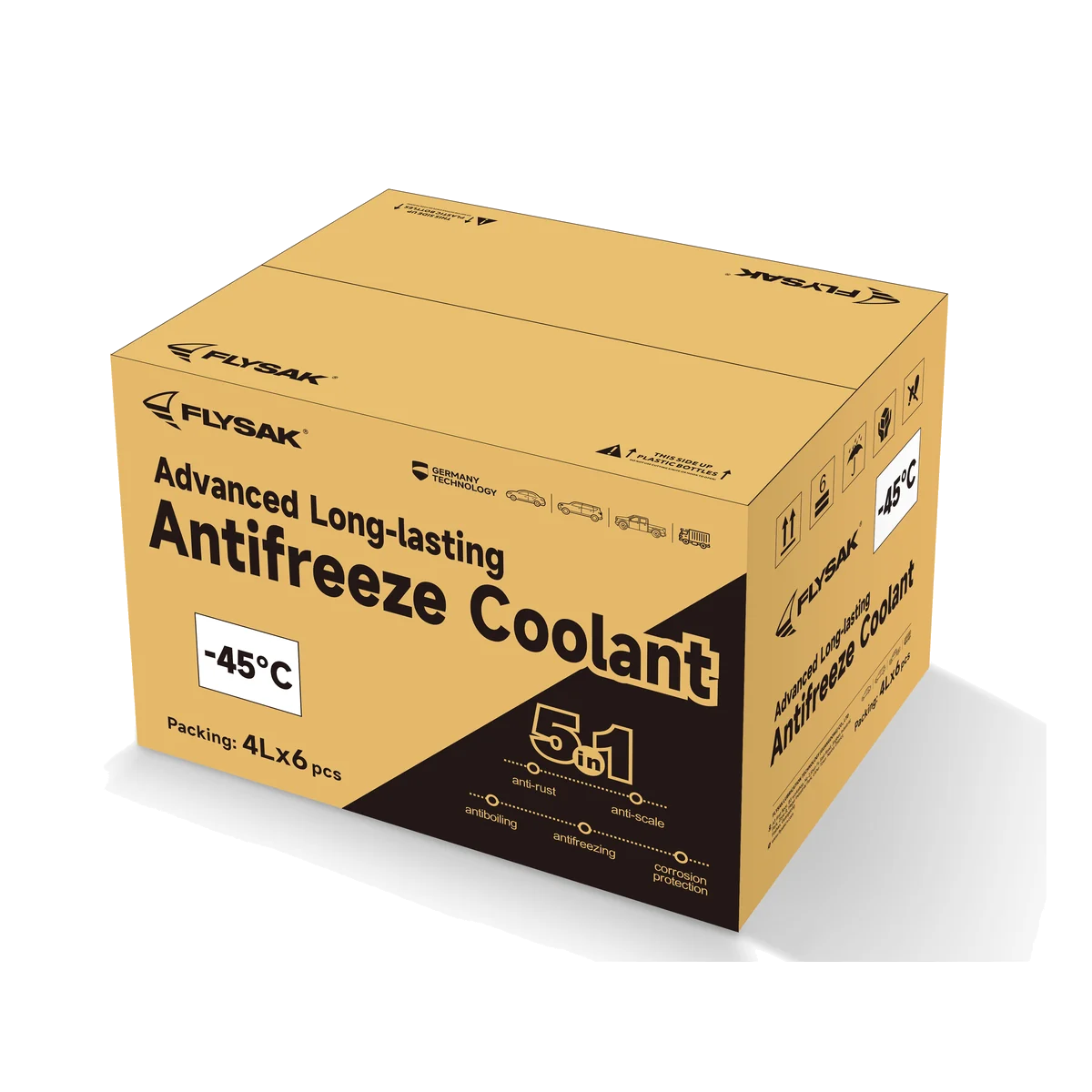
Approve a production-representative bottle and carton. Check fluid appearance, fill level, closure and seal, label adhesion, barcode, carton marks and traceability. Keep the signed artwork revision with the product documents so a later colour or formula change cannot pass as a routine design update.
- Review FLYSAK private-label support — Connect product, samples, documents and packaging in one approval route.
Make receiving and change control part of the purchase
Receiving inspection should match the purchase order, product code, formulation reference, label revision, batch code and shipping documents before stock is released. Inspect container condition, seal integrity, label placement and obvious changes in appearance. Use the agreed COA fields and limits for batch acceptance instead of judging fluid colour by eye alone.
Define notification rules in writing. A change to glycol source, inhibitor package, dye, water treatment, specification claim, test method, bottle, cap, label material or production location can affect documents, appearance, compatibility evidence or market compliance. The buyer should know which changes require notice, new samples, updated evidence, revised SDS or fresh artwork approval.
Keep retained samples and complaint records under an agreed plan. When a field issue occurs, product code, batch, vehicle, existing coolant, service history and mixing event are more useful than a photograph labelled wrong colour.
Send an RFQ that exposes compatibility gaps
A useful RFQ lists destination countries, important vehicles and model years, manufacturer coolant specifications, existing coolant concerns, required supply form, freeze-protection range, pack sizes, label languages, order mix and document needs. Mark every uncertain application instead of asking for one universal red or green coolant.
Ask the supplier to return a product map with evidence status, exclusions, TDS, SDS, sample and test plan, COA proposal, packaging configuration and change-control terms. Compare like with like: the same technical requirement, evidence level, pack, carton, artwork scope and trade term. MOQ, price and lead time should be quoted only after that configuration is clear.
FLYSAK can review a buyer's vehicle and coolant brief against its current catalogue and prepare a private-label proposal. The final product, compatibility wording, documents, packaging and commercial terms remain subject to the confirmed written offer.
- Use the coolant supplier checklist — Compare supplier evidence, samples, packaging and batch controls.
- Send your coolant sourcing brief — Share vehicle requirements, specifications, pack sizes and target markets for review.
Frequently asked questions
Does coolant colour show its chemistry?
No. Colour is not a universal chemistry code. Products with the same colour can use different formulations or specifications, and compatible products can be dyed differently. Verify the exact product, inhibitor route, concentration and vehicle requirement.
Can two coolants of the same colour be mixed?
Not on colour evidence alone. Confirm the current vehicle-manufacturer mixing instruction and documented compatibility of the exact products. If the existing fluid cannot be identified, follow the manufacturer's approved service procedure rather than guessing.
Can coolants of different colours be compatible?
Possibly, but colour cannot prove or disprove it. Compatibility depends on the exact formulations and vehicle requirement. Obtain written, product-specific evidence and follow the vehicle manufacturer's instructions.
Does meeting ASTM D3306 mean a coolant fits every passenger car?
No. ASTM D3306 is an industry specification for defined glycol-base coolants used in automobiles and light-duty service. A vehicle can also require a manufacturer specification or approval. Check both the industry evidence and the exact vehicle requirement.
Which coolant tests should an importer request?
Start with the applicable product specification and vehicle requirement, then ask which qualification and batch tests support them. Freezing point, boiling point, corrosion, pH, density and foaming address different properties; no single result proves complete compatibility.
What documents should accompany a private-label coolant sample?
Request the current TDS and SDS, written product specification, claim or approval evidence, representative test reports, sample COA, compatibility matrix, pack specification, artwork brief and change-control procedure. All should identify the same proposed product.
What is the MOQ for a private-label coolant colour?
There is no responsible universal figure. The applicable quantity depends on the formulation, dye or appearance requirement, bottle, cap, label, carton, artwork versions and SKU mix. Request a written quotation against the approved technical and packaging brief.
Sources
Technical and regulatory references reviewed for this article:
- ASTM D3306-21 — Glycol Base Engine Coolant for Automobile and Light-Duty Service — Reviewed for the scope and categories of glycol-base concentrate and prediluted light-duty coolants.
- ASTM D1177-22(2026) — Freezing Point of Aqueous Engine Coolants — Reviewed for the role of a defined freezing-point test method.
- ASTM D1120-26 — Boiling Point of Engine Coolants — Reviewed for the scope of equilibrium boiling-point measurement.
- ASTM D1384-24 — Corrosion Test for Engine Coolants in Glassware — Reviewed for controlled laboratory evaluation of coolant effects on metal specimens.
- BASF GLYSANTIN — Usage and Maintenance — Reviewed for the limitation of colour as an indicator of coolant chemistry and properties.
- Ford Owner Information — Engine Coolant Check — Reviewed for manufacturer guidance on specification-led selection, mixing and normal colour change.