

Table of contents
- What is the actual difference between C2 and C3?
- Build the application brief before choosing the stock line
- Can one oil legitimately claim both C2 and C3?
- Request evidence without asking for a misleading certificate
- Use catalogue products as a shortlist, not a substitute verdict
- Turn the comparison into a clear RFQ and artwork brief
- Keep the approved decision usable for repeat orders
- Related procurement guides
- Frequently asked questions
- Sources
What is the actual difference between C2 and C3?
ACEA's 2023 light-duty sequences describe both as mid-SAPS categories for aftertreatment compatibility. SAPS refers to sulphated ash, phosphorus and sulphur. Their minimum high-temperature, high-shear viscosity differs: C2 requires at least 2.9 mPa·s, while C3 requires at least 3.5 mPa·s. The C2 limit is not a statement that every C2 oil is below 3.5. This distinction matters when evaluating a possible combined claim.
For purchasing, use the comparison below as a screening aid, not a shortened specification. It deliberately does not reproduce the full test programme. A result for one property cannot demonstrate that a formulation satisfies an entire category, and the comparison is not a recommendation for a particular engine.
| Review point | ACEA C2 | ACEA C3 | Importer action |
|---|---|---|---|
| Minimum HTHS | 2.9 mPa·s | 3.5 mPa·s | Check the complete claim |
| SAPS description | Mid-SAPS | Mid-SAPS | Do not infer interchangeability |
| SAE grade alone | Not enough evidence | Not enough evidence | Retain all required designations |
| Vehicle coverage | Application-specific | Application-specific | Review exact manufacturer requirements |
Build the application brief before choosing the stock line
Start with the vehicles your customers actually service, rather than a general label such as European cars. Record the engine identifier, model year, destination market and the source of the oil requirement. Where a workshop asks for a replacement product, request the underlying vehicle requirement as well as the name of the oil it previously used.
Give each application a row. Keep the required SAE grade, ACEA category and manufacturer specification or approval separate. A salesperson should be able to see which requirement has been confirmed and which remains open. If a document is ambiguous, retain its wording and ask the technical reviewer to resolve it instead of simplifying it into a broader claim.
For example, two customer groups may both request 5W-30 but have different performance requirements. That is a reason to investigate separate products, not proof that either group needs C2 or C3. Do not use climate, vehicle age or a broad brand name to fill a missing specification. When demand is uncertain, price the confirmed group separately and leave the unresolved volume visible.
Can one oil legitimately claim both C2 and C3?
ATIEL explains that combined ACEA claims are possible only when all relevant chemical limits and physical testing requirements are satisfied. It specifically rejects a C2 claim that excludes fuel economy. A C3 statement therefore does not, by itself, establish C2 performance. Conversely, a properly supported combined claim should be assessed on its actual evidence rather than rejected simply because two categories appear together.
Ask the supplier to identify the exact offered product, the basis of the combined statement and the person responsible for its technical confirmation. Keep the response with the product revision being quoted. A general brochure, an additive-package reference or another SKU's document does not close that product-specific question. If the answer is incomplete, continue with separate purchasing lines until it is resolved.
Even after a combined performance statement is supported, compare it with every row of the application brief. Range consolidation is a commercial decision that follows technical confirmation; it should not be the reason the reviewer is pressured to approve a broader fitment list. Keep any restrictions attached to the product wherever the sales team can see them.
Request evidence without asking for a misleading certificate
ATIEL describes ACEA performance claims as self-certifying and says ACEA-approved or ACEA-certified are not valid claim descriptions. Do not confuse this framework with a separate vehicle-manufacturer approval. Ask for the current claim basis and applicable conformance arrangements rather than insisting on an ACEA approval certificate that misstates the system.
A practical review file can include the current TDS, the agreed finished-product specification, claim-supporting confirmation, SDS and the proposed batch-document scope. Record which question each item answers. A COA for a shipment may help check agreed release properties, but it should not be promoted into a substitute for complete performance-claim evidence or vehicle approval.
Ask which sequence issue supports the formulation and verify its validity against the current official material. ATIEL's current directory identifies 2023 as the light-duty issue when checked for this article. Keep that development-record question distinct from the approved customer-facing wording. If documents conflict, record the conflict and obtain a corrected, controlled version before artwork approval or an order commitment.
| Purchasing question | Evidence to request | Do not infer |
|---|---|---|
| What is being offered? | Exact SKU and current product revision | Coverage from a similar product |
| What claims are supported? | Written category and combined-claim basis | Full performance from one test |
| Is an OEM approval required? | Applicable approval evidence for that product | Approval from an ACEA reference |
| What will the buyer receive? | Approved filled pack and document scope | Shipment conformity from a sample image |
| Who closes a gap? | Named reviewer and recorded decision | Acceptance from an unanswered email |
Use catalogue products as a shortlist, not a substitute verdict
FLYSAK's current catalogue lists EO-009 QN-F9 5W-30 with an ACEA C3 performance reference. Use that as a product discussion starting point and request the current documents for the precise offer. The listing does not establish a C2 claim, a combined C2/C3 offer or approval by any vehicle manufacturer. No C2 product availability is asserted in this guide.
This boundary is especially important when an importer is comparing several products in the same viscosity. Give the supplier the application worksheet and ask it to identify supported rows, unresolved rows and rows requiring another product. A useful response should preserve those distinctions rather than returning a broad statement that the entire range is suitable.
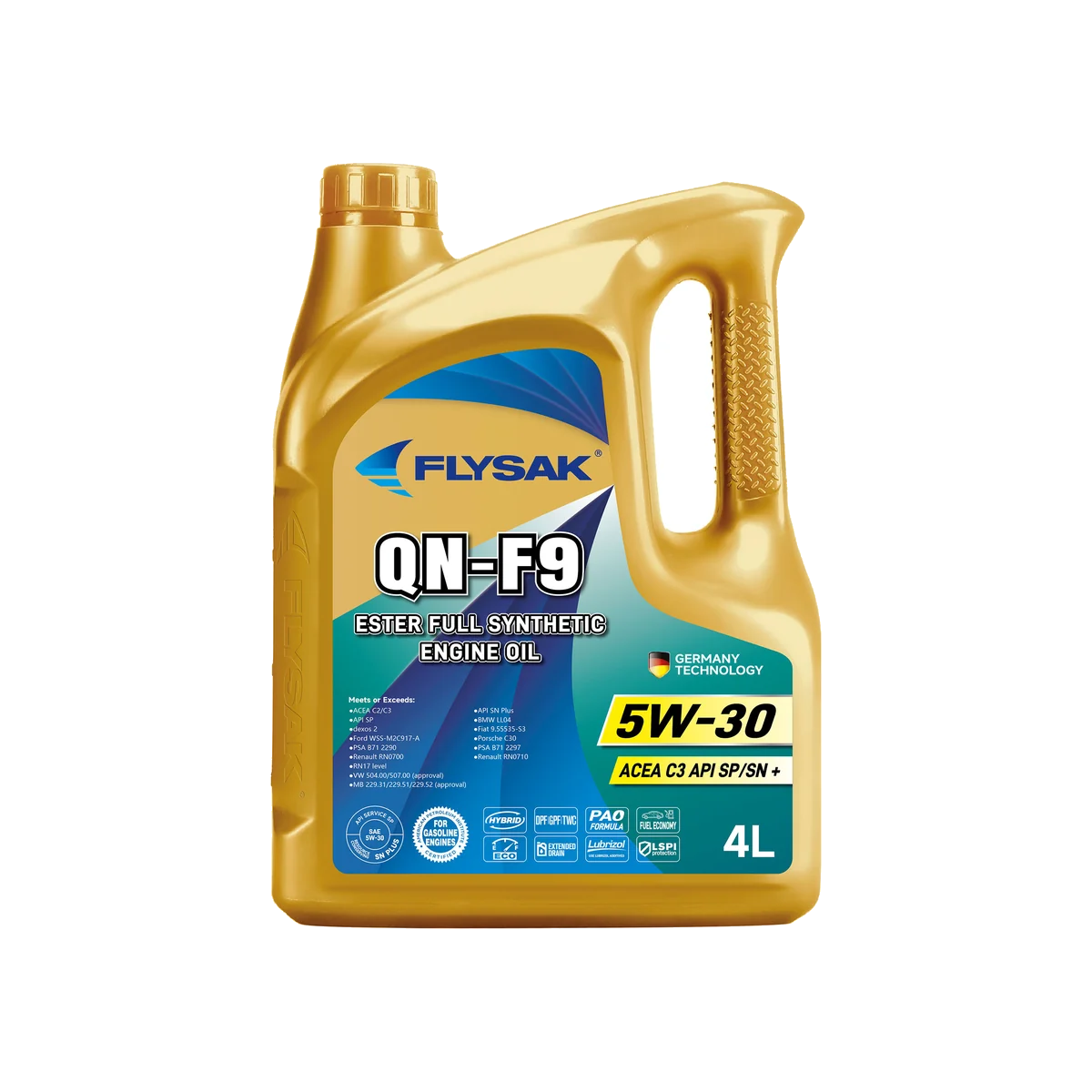
- Review the EO-009 5W-30 C3 product reference — Start an exact-product document and application discussion.
- Compare separate passenger-car engine oil profiles — Keep performance requirements separate even where SAE grades match.
Turn the comparison into a clear RFQ and artwork brief
Send the confirmed applications, required claims, destination countries, channel and expected demand by product line. Add the desired filled-pack format, label languages, carton configuration and delivery basis. Ask suppliers to quote the same scope and identify any assumptions. Keep product approval, packaging approval and the commercial offer as three explicit decisions.
For private label, give each approved statement an evidence reference and an owner. Review the front panel, back label, carton and online description together so one surface does not promise more than the others. A convenient phrase such as for all European cars should not replace a reviewed application scope. Approve the actual wording before producing artwork quantities or using it in a distributor catalogue.
Do not merge two quotation lines just because one pack is cheaper or a larger combined order seems easier. First resolve whether the proposed product meets the full brief. Then compare the finished-pack cost, document scope, delivery responsibilities and any remaining restrictions. Confirm MOQ, lead time and pack availability in the current proposal; this guide supplies none of those commercial figures.
- Plan a private-label lubricant project — Define the product, claim and pack approvals before a brand launch.
- Send your engine oil application and purchasing brief — Ask for a current product-specific proposal with unresolved requirements marked.
Keep the approved decision usable for repeat orders
Retain the reviewed application list, supplier response, product revision and approved wording with the purchase record. Give warehouse and sales teams a clear product identifier so an abbreviated order description does not become a substitution instruction. If a repeat quote changes the product name, claim set or document revision, review the change before treating it as the same stock item.
The useful output is a short decision record: which applications are supported, which evidence was checked, what remains excluded and who authorised the order. That record is more valuable to an importer than a comparison chart copied into every sales email. These are suggested buyer controls, not a description of FLYSAK's internal procedure or a guarantee of any application outcome.
Frequently asked questions
Can an importer replace a C2 order with C3 oil?
Not from the category name alone. Check the complete vehicle requirement and the offered product's evidence. Keep the proposed replacement unapproved until the responsible reviewer confirms the actual application scope.
Does 5W-30 mean two engine oils are interchangeable?
No. Keep the SAE grade, performance category and any manufacturer requirement separate. Compare all required fields before merging stock or accepting a substitution.
Is every C2 oil below 3.5 mPa·s HTHS?
No. The C2 requirement shown here is a minimum, not that upper limit. Assess the complete category evidence rather than inventing a universal C2 viscosity band.
Can one product carry a C2/C3 claim?
A combined claim requires the complete requirements for both categories to be satisfied. Do not infer it from a C3 statement, a single property result or an incomplete C2 claim.
Should buyers request an ACEA approval certificate?
Request the correct performance-claim evidence and applicable conformance information. ACEA claims are self-certifying; do not present that as a separate OEM approval.
Does the EO-009 catalogue listing establish C2 availability?
No. The cited catalogue reference is C3-positioned. This guide does not establish a C2 or combined-claim offer; request the current exact-product proposal.
What should a private-label RFQ contain?
Include the application worksheet, required claims, destination and channel, expected demand by line, filled-pack format, artwork languages and delivery basis. Ask for assumptions and unresolved technical points to be stated before commercial comparison.
Sources
Technical and regulatory references reviewed for this article:
- ACEA 2023 Light-duty Oil Sequences, Revision 0 — Reviewed the category descriptions and C-category table, including HTHS minima and application limitations. This is not the full specification or proof of a FLYSAK claim.
- ATIEL: ACEA Oil Sequences - Performance Claims — Checked combined and incomplete claims, self-certification and the distinction between valid ACEA claim wording and approval language.
- ATIEL: ATC Code of Practice and current ACEA sequences — Checked the listed current light-duty sequence issue and the role of testing and records in supporting performance claims on October 30, 2026.