
Table of contents
- Define the sellable coolant line before discussing its minimum
- Ask for the minimum at the level that creates it
- Work back from customer demand, not spare container space
- Reduce avoidable variants without changing the technical requirement
- Check cartons, weight and loading after the mix is credible
- Approve receipt and stock controls before buying the balance
- Test whether the second order still makes sense
- Send a coolant RFQ that can be answered line by line
- Related guides for coolant procurement
- Frequently asked questions
- Sources
Define the sellable coolant line before discussing its minimum
A purchasing line should identify the supplier product code, documented application, supplied form, pack size and artwork revision. Two bottles with the same colour or nominal volume are not necessarily the same inventory item. A different product, protection statement, language panel or carton can create a separate line to approve and replenish.
Keep the technical review separate from the quantity discussion. ASTM's current public listing identifies D3306-21 as a specification for glycol-base automotive and light-duty coolant. That reference does not establish that a particular offer complies or fits a vehicle. Request evidence for the proposed product rather than merging requirements to make a larger production run.
FLYSAK's published coolant catalogue currently has AC-001 and AC-003 references in 4L packaging, with a 4L × 6 carton reference shown for AC-003. These are useful starting points for a request, not confirmation of minimum quantities, current stock or every available packaging configuration. Confirm the exact product documents and commercial pack in the proposal.
- Identify the current FLYSAK coolant product references — Start the order worksheet with a named product and pack rather than a generic coolant line.
Ask for the minimum at the level that creates it
A quotation saying minimum order quantity leaves an important question unanswered: minimum for what? Ask whether the condition applies per formulation, filled SKU, bottle configuration, printed label, carton revision or overall order. These are possible constraints to investigate, not a statement that every supplier uses all of them.
Have the supplier return the quantity and unit beside each applicable condition. If a printed component needs a larger run than the filled-product order, ask who owns the surplus, where it is stored and what happens if artwork changes. Record not applicable where appropriate; do not invent a requirement to fill every row.
| Planning level | Question for the proposal | Buyer decision |
|---|---|---|
| Product or formulation | Is there a minimum for this exact approved product? | Keep unlike applications separate |
| Filled pack | Does each bottle and closure configuration have its own minimum? | Choose a manageable launch pack |
| Printed label | Does each artwork or language revision create a print quantity? | Approve versions and surplus ownership |
| Carton | What quantity applies to the agreed carton and print? | Match carton demand to filled units |
| Total order | Which approved lines may be combined, under what conditions? | Obtain the actual mix in writing |
| Reorder | Which conditions change when existing components are reused? | Check repeatability, not only launch acceptance |
Work back from customer demand, not spare container space
List the workshop, retail or distributor customers expected to buy each line. Separate confirmed commitments from a sales forecast and an unsupported hope. A familiar product in an existing channel deserves a different stock decision from a new specification that has not yet been evaluated by a customer.
A starting quantity can be built from expected sales during the chosen coverage period, an explicit reserve and usable stock already available. Use your own records for those inputs. For a new line, request distributor feedback or a controlled customer evaluation before committing launch inventory. The calculation is a planning aid, not a demand forecast supplied by FLYSAK.
Then test the supplier's minimum against that demand. If it leaves excessive stock, explore fewer pack or artwork variants, a different agreed order mix, staged purchasing if offered, or deferral of the line. Do not assume any of these options is available. The point is to expose the conflict before a purchase order makes it expensive.
Reduce avoidable variants without changing the technical requirement
A launch range does not need a separate bottle, closure and carton design for every marketing idea. Ask whether compatible packaging components can be shared across approved products while maintaining unmistakable product identification. Any simplification must be reviewed for the actual fluid, filled sample and sales channel.
Do not solve a minimum-order problem by replacing one required coolant with another on colour alone. Likewise, do not describe a ready-to-use product as concentrate to make the economics look different. Keep application, product form, protection claim and the supporting documents fixed while discussing commercial alternatives.
For private label, settle the artwork owner and revision process early. Have the importer review destination-language and label requirements before printing. One approved version that genuinely serves the intended channel is easier to manage than several speculative variants, but a shared label is not a substitute for required local information.
- Review the private-label approval route — Discuss product, packaging and artwork scope before accepting an order minimum.
Check cartons, weight and loading after the mix is credible
Translate the agreed bottle quantities into complete cartons using the confirmed pack specification. For the published AC-003 4L × 6 reference, the six-bottle arrangement is a catalogue reference, not a universal carton rule for the rest of the range. Ask for current dimensions and weights instead of estimating them from the photograph.
The International Trade Administration's packing-list guidance identifies package contents, weights and measurements as useful shipment information. Use that principle to reconcile the order sheet with the proposed packing list. Its U.S. export context does not determine the legal documents required for a China-origin shipment to your destination.
Ask the supplier and forwarder to check the actual loading proposal, including packaging, pallets if used, permitted load, handling and delivery constraints. Do not quote a universal number of coolant cartons per container. A load plan must be checked for the selected equipment and route; floor space alone does not establish that the shipment is acceptable.
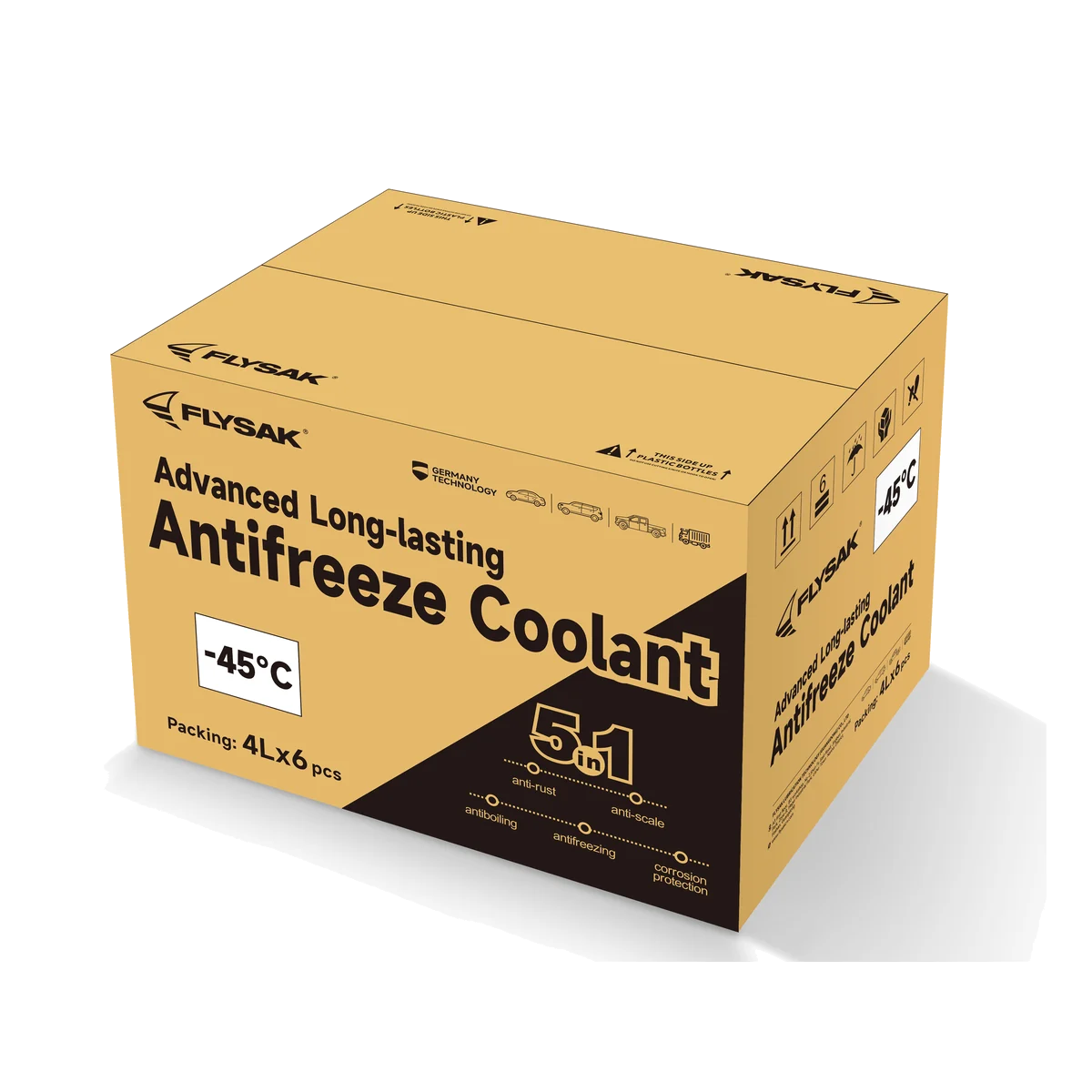
- Review the AC-003 coolant and carton reference — Use the specific product record when confirming the proposed commercial pack.
Approve receipt and stock controls before buying the balance
A larger order needs a receiving plan, not just a lower quoted unit price. Agree the checks for product identity, label revision, seals, leakage, carton condition, batch codes and the documents associated with the shipped lots. Define who can release stock and how a discrepancy will be handled before onward distribution.
Request the exact product's storage instructions, date coding and documented shelf-life basis. Consider remaining usable life after the expected transport and sales period. No universal coolant shelf life or permitted storage temperature is asserted here. Do not transfer a value from another brand, formula or packaging system.
NIOSH's ethylene-glycol guidance identifies ingestion and skin or eye contact as exposure routes and recommends avoiding skin and eye contact. The finished product's SDS should guide the warehouse's handling review. Confirm spill-response responsibilities and appropriate storage arrangements locally; a purchase quantity does not establish the product's hazard or transport status.
Test whether the second order still makes sense
Before approving the launch, sketch a reorder using the mix you expect to sell, not the launch mix copied unchanged. Ask what happens if one line sells more quickly, another needs no replenishment and printed components remain unused. A minimum that works only when every product sells at the same rate can create recurring excess stock.
Request written treatment of unused custom materials and changes to labels or packs. Identify any applicable storage charge, reuse condition or expiry requirement rather than assuming free or indefinite storage. Keep delivery timing tied to confirmed approvals and component availability; this guide does not promise staged delivery, component reservation or a fixed lead time.
| Issue | Launch decision | Reorder check |
|---|---|---|
| SKU mix | Quantities supported by the launch channel | Can the faster-selling line be reordered separately? |
| Artwork | Approved files and identifiable revision | What triggers reapproval or new printing? |
| Unused components | Quantity, ownership and agreed treatment | Are remaining materials still suitable and available? |
| Stock evidence | Opening quantities and lot records | Use actual sales and usable stock, not the original forecast |
Send a coolant RFQ that can be answered line by line
Send the destination market, buyer channel, vehicle requirements, exact product candidates, supplied form, proposed packs, artwork languages and quantities per line. Mark which quantities are committed and which are forecast. Ask the supplier to return each applicable minimum, the permitted mix, sample and document scope, packaging details and unresolved items.
For FLYSAK, use the published coolant references to start that discussion and request a current product-and-pack proposal. Treat minimums, stock, timing and mixed-order conditions as quote-specific until confirmed in writing. The outcome should be a practical first shipment and an understandable replenishment route, not merely a full container.
- Send your coolant first-order planning brief — Share product candidates, channel demand, packs and quantities for a proposal-specific review.
Frequently asked questions
What is the minimum order quantity for private-label coolant?
There is no universal figure. Request the minimum for the exact product, filled pack, printed components and total order. FLYSAK minimum quantities must be confirmed in the current written proposal, not inferred from a catalogue image or this guide.
Does one container automatically satisfy every coolant MOQ?
No. An overall shipment quantity does not resolve separate product or packaging constraints. Have the supplier confirm which lines can be combined and whether the proposed quantity meets each applicable condition.
Can an importer mix coolant products in the first order?
Ask for confirmation of the exact products, quantities and packaging mix. Mixed-order availability and commercial conditions are proposal-specific; do not assume unrestricted mixing or a fixed container minimum.
Should I add another coolant colour to reach the minimum?
Not without a defined customer need and technical review. Colour does not establish compatibility. First consider whether fewer pack or artwork variants, another agreed mix or deferring an unproven line is commercially possible.
Does the AC-003 carton reference apply to every FLYSAK coolant?
No. The current AC-003 record shows a 4L × 6 carton reference. Confirm each product's actual pack, carton dimensions, weights and availability in the proposal instead of transferring that configuration across the range.
What should happen to unused private-label packaging?
Agree its quantity, ownership, storage, charges if applicable and suitability for reuse. Define how artwork or product changes affect it. Do not assume the supplier will hold components indefinitely or use them for a revised product.
What if the minimum is larger than my likely sales?
Explain the demand gap before ordering. Ask which reductions in variants or changes to the order plan are actually available, then compare inventory exposure and replenishment needs. A lower unit price does not by itself justify stock you cannot reasonably sell.
Sources
Technical and regulatory references reviewed for this article:
- ASTM D3306-21 public specification listing — Checked the active designation and automotive/light-duty coolant scope; not evidence of FLYSAK compliance, vehicle approval or MOQ. No full standard reproduced.
- International Trade Administration: Packing List — Supports reconciling package contents, weights and measurements. U.S.-oriented guidance is not treated as the destination's legal document checklist.
- CDC/NIOSH Pocket Guide: Ethylene glycol — General ingredient exposure and skin/eye protection context; the exact finished-product SDS remains necessary and transport classification is not inferred.