

Table of contents
- Start with the complaint and operating conditions
- Separate fuel, viscosity and water in the laboratory request
- Make samples comparable before comparing suppliers
- Read dilution-control claims as a separate evidence file
- Connect trial evidence to production and complaint handling
- Send a sourcing brief built around the vehicles you serve
- Frequently asked questions
- Sources
Start with the complaint and operating conditions
Toyota's 2025 Highlander Hybrid manual explains that repeated operation without full engine warm-up can allow unburned fuel or condensed moisture to enter the oil and raise its level. It identifies short-distance, low-speed and cold-weather operation as examples. That is a useful OEM explanation for one vehicle, not evidence that every hybrid has the same dilution rate or that every rising level indicates a failed lubricant.
For an importer, the first task is to collect a usable case record. Identify the model year, engine, market, service mileage and date, installed oil, fill quantity, top-ups, typical trip pattern and how the level was checked. Ask the workshop to record warning messages and its inspection findings. A complaint with only a brand name and a photograph of a dipstick is difficult to investigate fairly.
Keep this record separate from a sales claim. 'Suitable for the specified engine' and 'reduces dilution under a defined trial' are different statements with different evidence needs. If your distribution channel includes urban taxis or short-trip passenger vehicles, include that duty-cycle description in the sourcing brief before asking suppliers to propose an oil.
Separate fuel, viscosity and water in the laboratory request
ASTM D7593-22 describes gas chromatography for quantifying fuel dilution in in-service engine oils. Its public scope includes gasoline applications and notes limitations in identifying the specific aged fuel present. Request the method edition, sample identity, reported result and unit. The method is a measurement procedure, not a universal condemnation limit for every hybrid engine.
ASTM D445-26 measures kinematic viscosity. It can support a comparison between a used sample and an appropriate fresh-oil reference, but a viscosity result alone is not a direct measurement of fuel content. ASTM D6304-25 addresses water by coulometric Karl Fischer titration. These measurements answer separate questions; ask the laboratory to identify the procedure and any relevant limitations rather than treating them as a single 'hybrid oil test'.
Agree the interpretation with the laboratory and responsible technical reviewer before the trial. A supplier's pass/fail label is useful only if its criterion and application basis are visible. Avoid importing a percentage limit from an unrelated engine, fleet or internet discussion into your purchase specification.
| Buyer question | Evidence to request | What it does not prove |
|---|---|---|
| How much fuel is in the used oil? | Traceable fuel-content report, such as ASTM D7593-22, with unit and method details | A universal failure limit or the root cause |
| Has viscosity changed? | Used and fresh-reference viscosity results at the same temperature and method | Fuel content from viscosity alone |
| Is water also present? | Water result with the laboratory procedure, such as ASTM D6304-25 | The source of water without vehicle investigation |
| Does this comparison support a product claim? | Matched trial conditions, sample history and complete results | Performance in every hybrid or a longer service interval |
| Does the shipment match the reviewed oil? | Formulation identity, batch COA and finished-pack trace code | Field dilution control from fresh-oil checks |
Make samples comparable before comparing suppliers
A strong-looking laboratory report can still be a poor comparison. One supplier may present oil from a vehicle used on long journeys while another shows a winter delivery fleet. One sample may follow several top-ups; another may come from the first fill after a service. Treat these as different observations until the history is documented, not as a product ranking.
Ask the laboratory or workshop to define a repeatable sampling procedure. Record the sampling point, date, vehicle mileage, distance and elapsed time on the oil, recent operation, top-up history, container identity and dispatch details. Use labelled samples and retain the full report. The exact collection and handling instructions should come from the laboratory; this guide is not a substitute for them.
For a comparison trial, agree the vehicle groups, operating conditions, sampling schedule and review criteria in advance. Keep an identified fresh-oil reference for each candidate. Record deviations and missing information openly. A controlled small trial can help a buying decision, but it should not become a blanket promise for a country-wide vehicle population.
Read dilution-control claims as a separate evidence file
When a supplier says its oil offers better protection under fuel dilution, ask what was actually compared. Was the work an engine trial, a controlled laboratory assessment or an observation from customer samples? Which formulations, vehicles and conditions were involved? Request the complete result and the limitations, not only the strongest chart in a presentation.
Also ask what the claim means. Measuring fuel already present, evaluating an oil under a specified contamination condition and demonstrating reduced fuel entry into an engine are not equivalent propositions. The supplier should identify the question its evidence addresses. Do not let the label imply a repair for a vehicle condition that the study did not investigate.
API's Motor Oil Guide explains its quality marks and service categories. Those are useful selection references, but they are not an individual used-oil report from your target hybrid fleet. Review category and licence evidence for their own purpose, then ask for any additional evidence behind a dilution-specific statement. Keep the approved wording narrower than the available proof.
- Review the hybrid engine oil supplier guide — Use the separate vehicle-fitment and range-planning checklist.
- Check how to verify an API engine oil licence — Keep licensing evidence separate from field-trial claims.
Connect trial evidence to production and complaint handling
Once a candidate is accepted, identify the formulation and commercial SKU in the approved technical file. Connect the TDS, SDS, trial reports, production specification, sample COA and final label to that identity. Require notice when a proposed formulation change could affect the evidence you reviewed. A familiar product name is not sufficient change control.
The production COA remains valuable for checking agreed batch-release properties. It does not repeat a vehicle trial or measure fuel that enters after the oil has been sold. Keep routine release records and in-service investigations in separate folders, with a common trace code linking the finished bottle to the shipped batch.
Set a complaint route with your distributor before launch. Specify who collects vehicle details, who authorises sampling, which laboratory is used and who reviews the findings with the workshop. Preserve unresolved cases as unresolved; neither the supplier nor importer benefits from blaming a batch or a vehicle without enough evidence.
- Read the engine oil COA review guide — Define what routine batch-release records can establish.
Send a sourcing brief built around the vehicles you serve
A useful RFQ states the destination market, target hybrid models and engines, required oil specifications, sales channel, typical operating conditions, pack sizes and proposed order mix. Add your evidence questions: available formulation-specific trials, laboratory support, traceability and the scope of any dilution-related claim. This lets suppliers identify both coverage and information gaps.
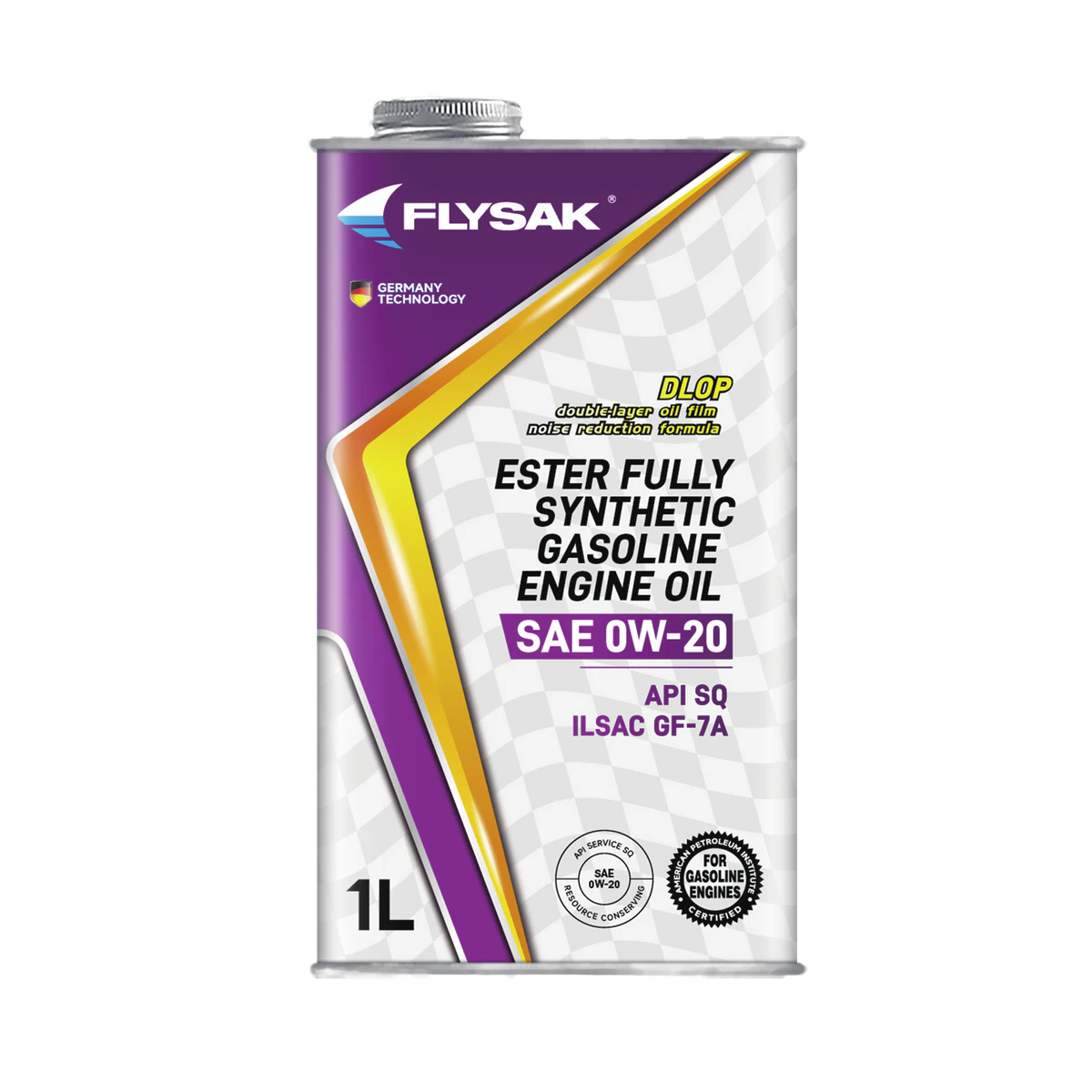
FLYSAK's passenger-car catalogue includes EO-021 SAE 0W-20 positioned around API SQ and ILSAC GF-7A, among other product routes. It is a starting point for a document review where the vehicle requirement matches, not evidence of a special fuel-dilution advantage. Request current product documents and any relevant trial evidence for the exact proposal before approving private-label copy.
Compare quotations on the same product, pack, document and technical-support scope. Confirm commercial terms in writing rather than assuming laboratory work is included in the oil price. A clear boundary between verified fitment, available evidence and unresolved questions makes the first order easier to manage and later distributor conversations more useful.
- Review the EO-021 0W-20 product profile — Check the published profile and request the current documents.
- Discuss a private-label oil programme — Coordinate the proposed formulation, artwork and purchasing scope.
- Send your hybrid oil evidence brief — Share your vehicle list, operating conditions and document requirements.
Frequently asked questions
Does every hybrid engine have excessive fuel dilution?
No. A vehicle's operating conditions and inspection findings matter. An OEM discussion for one model is not a dilution rate or diagnosis for every hybrid. Collect the exact vehicle and oil-service history before comparing evidence.
Can a fresh-oil COA show hybrid fuel dilution performance?
No. A fresh-oil COA records agreed batch properties before use. In-service dilution requires a traceable used sample, relevant laboratory measurements and a documented vehicle history.
Is lower used-oil viscosity enough to prove fuel dilution?
No. A viscosity measurement is not a fuel-content measurement. Ask the laboratory to review direct fuel testing, the fresh-oil reference, sample history and other relevant results together.
What fuel-dilution percentage should importers use as a rejection limit?
Do not set a universal percentage from an unrelated report. Agree a vehicle-appropriate interpretation and action criteria with the responsible technical reviewer and laboratory, considering the method and OEM guidance.
Should a hybrid oil label promise longer service intervals?
Only use wording supported for the exact application and consistent with the manufacturer's maintenance requirements. A dilution report or a hybrid product name alone does not justify extending the interval.
What should a supplier provide for a dilution-control claim?
Request the exact formulation, study type, comparison oil, operating conditions, sampling history, methods, complete results and stated limitations. Confirm that the evidence supports the proposed label wording.
What belongs in an importer's trial request?
Include target vehicles and specifications, duty cycle, service history, sampling procedure, laboratory methods, review criteria, product and batch identity, and responsibilities for handling unexpected findings.
Sources
Technical and regulatory references reviewed for this article:
- Toyota 2025 Highlander Hybrid Owner's Manual — Engine compartment — Reviewed the model-specific explanation of oil-level rise during operation without full warm-up and the upper-level instruction.
- ASTM D7593-22 — Fuel Dilution for In-Service Engine Oils by Gas Chromatography — Verified the active edition, public measurement scope and stated interpretation limitations.
- ASTM D445-26 — Kinematic Viscosity — Verified the active edition and public scope of the viscosity measurement.
- ASTM D6304-25 — Water by Coulometric Karl Fischer Titration — Verified the active edition and public scope for water measurement in lubricating oils.
- API Motor Oil Guide — Reviewed the stated purpose of the guide: engine-oil quality marks and service categories.