

Table of contents
- Start with the specified fluid, not a universal CVT claim
- Separate CVT fluid from ATF, DCT fluid and MTF
- Map CVTF-1, CVTF-2 and NS-3-type routes separately
- Turn the compatibility list into a controlled claim matrix
- Request documents that describe the same product
- Approve samples and receiving controls before scaling the range
- Design the label and warehouse system to prevent misapplication
- Send an RFQ that can be audited row by row
- Frequently asked questions
- Sources
Start with the specified fluid, not a universal CVT claim
Vehicle manufacturers identify CVT fluids by their own service requirements. Honda's 2024 Civic guidance specifies HCF-2 for applicable CVT models and warns against mixing it with other transmission fluids. Nissan's Rogue owner manual specifies NS-3 or an equivalent meeting that requirement. These are application controls, not interchangeable names for every CVT fluid on the market.
An importer therefore needs more than a supplier statement that a product is suitable for Japanese vehicles or all belt CVTs. Record the destination market, make, model, model year, engine or powertrain where relevant, transmission code, specified fluid and source date. When any field is missing, mark the application unconfirmed rather than expanding the label claim.
Build the first product shortlist from the strongest vehicle clusters and workshop demand in the destination market. A smaller range with defensible application records is easier to sell, replenish and control than one universal SKU surrounded by exceptions.
| Application field | Evidence to collect | Purchasing use |
|---|---|---|
| Vehicle cluster | Make, model, model year and local parc evidence | Prioritise repeatable market demand |
| Transmission | Transmission type and code where available | Separate visually similar vehicles with different units |
| Specified fluid | Current owner manual or OEM service wording | Create the non-negotiable compatibility reference |
| Permitted alternative | Explicit manufacturer allowance, if any | Do not infer equivalence from a cross-reference |
| Service condition | Drain/fill method, level procedure and interval source | Keep product selection separate from workshop procedure |
Separate CVT fluid from ATF, DCT fluid and MTF
Transmission-fluid families are built around different hardware and friction-control needs. A stepped automatic transmission uses clutch packs and hydraulic controls; a belt- or chain-type CVT depends on controlled traction at the pulley interface; a wet dual-clutch transmission has its own clutch and gear requirements; and a manual gearbox may require a dedicated MTF or gear-oil route. Similar colour or viscosity does not make these fluids interchangeable.
Nissan's NS-3 service bulletin states that ATF or manual-transmission fluid should not be used in the listed Nissan CVTs and warns against mixing other fluids. For procurement, this means the product family should be the first filter in the database. Cross-reference work starts only after the transmission family and exact specified fluid are confirmed.
| Fluid family | Primary purchasing question | Do not assume |
|---|---|---|
| Conventional ATF | Which stepped automatic and OEM fluid requirement? | That an ATF name also covers a CVT |
| CVT fluid | Which CVT design, transmission and specified fluid? | That one CVTF covers every CVT |
| DCT fluid | Wet or dry clutch system and required specification? | That DCTF is a general ATF substitute |
| MTF / gear oil | Gearbox design, synchroniser needs and required grade? | That a GL or SAE label proves CVT suitability |
- Compare the current FLYSAK transmission-fluid range — Review the published ATF, CVT, DCT and MTF product families before requesting current evidence.
- Read the manual transmission oil supplier guide — Keep manual-transmission and gear-oil requirements outside the CVT compatibility matrix.
Map CVTF-1, CVTF-2 and NS-3-type routes separately
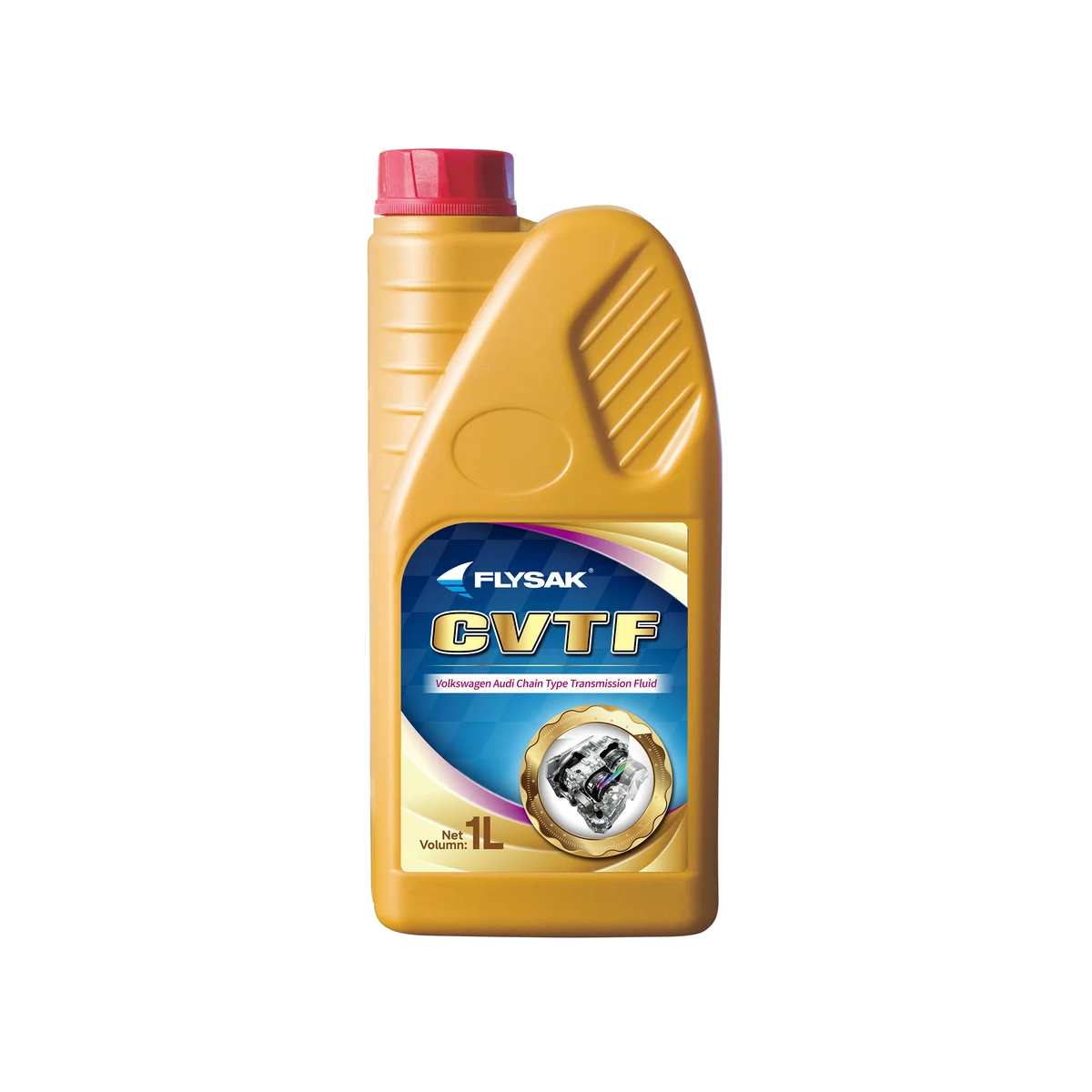
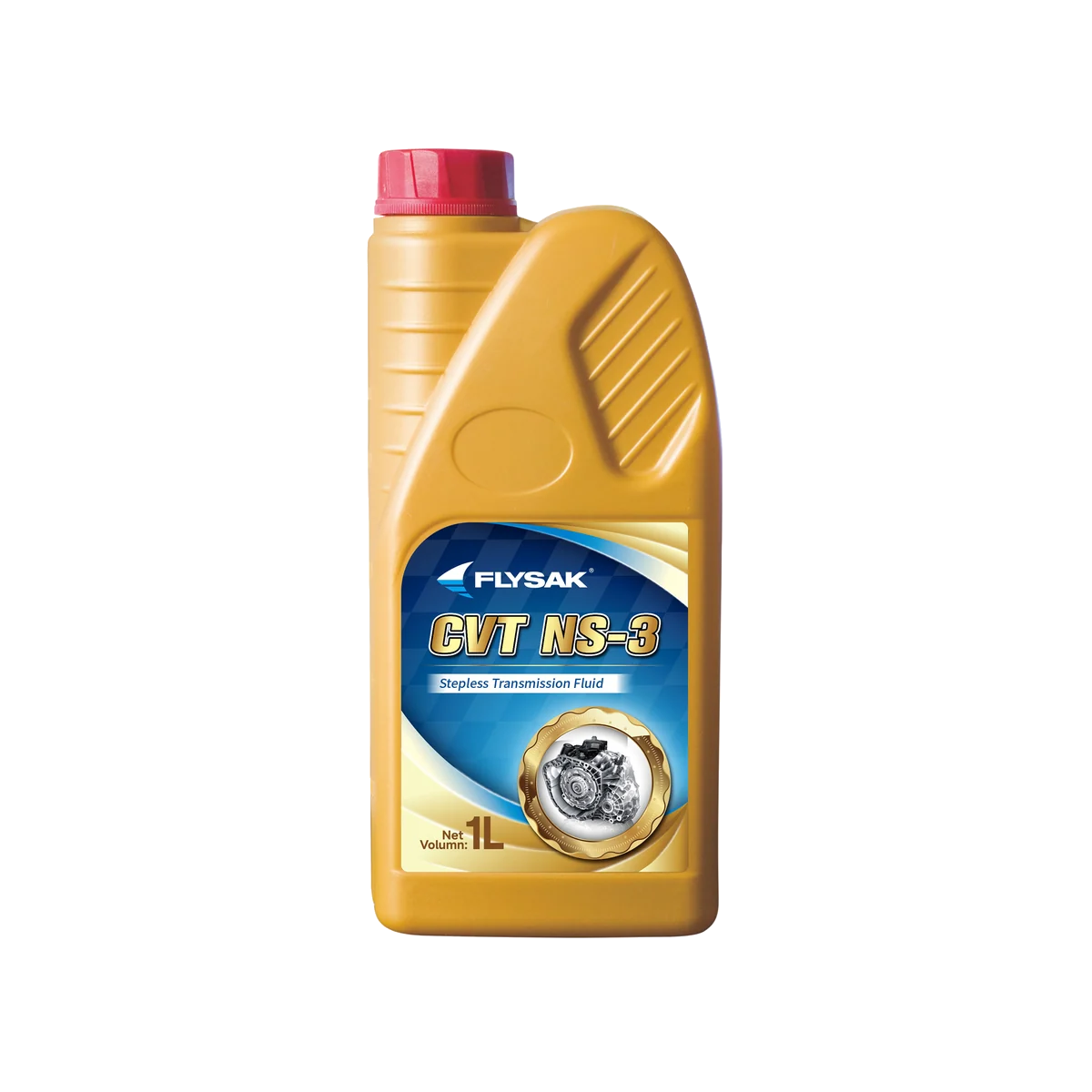
FLYSAK's current public catalogue presents three useful CVT sourcing routes: CVTF-1 for a broad belt- and chain-type CVT profile, CVTF-2 for newer low-viscosity CVT profiles, and CVT NS-3 for Nissan-family applications requiring an NS-3-type fluid. These names are product routes in the FLYSAK catalogue; they are not universal industry grades that can be substituted by name alone.
Use each public page as a shortlist, then request the current TDS and a written application statement for the exact proposal. Performance references on a supplier page are not blanket vehicle-manufacturer approvals. If a proposed private-label claim covers several OEM fluid identifiers, require the supplier to show how each entry was assessed and which applications remain excluded.
| Published product | Current catalogue position | Approval boundary |
|---|---|---|
| CVTF-1 · AT-006 | Belt- and chain-type CVT product route | Confirm every OEM-fluid reference and vehicle cluster |
| CVTF-2 · AT-015 | Newer low-viscosity CVT product route | Do not use ‘low viscosity’ as a compatibility shortcut |
| CVT NS-3 · AT-014 | Nissan-family NS-3-type product route | Confirm the exact transmission requires NS-3 or a permitted equivalent |
- Review FLYSAK CVTF-1 — See the current 1L product reference and its stated application boundary.
- Review FLYSAK CVTF-2 — Compare the published lower-viscosity CVT route before requesting current documents.
- Review FLYSAK CVT NS-3 — Review the NS-3-type route and its transmission-specific selection note.
Turn the compatibility list into a controlled claim matrix
A supplier cross-reference is a starting document, not final artwork. Convert it into a matrix with one row per fluid requirement or vehicle cluster. Link every row to the exact supplier product, evidence source, evidence date, allowed label wording and reviewer. Separate formal OEM approvals from performance references, recommendations and equivalence statements; those terms should not be merged in a sales claim.
Review edge cases before broad ones. The same vehicle name can use different transmissions by engine, model year or market. A later model may move to a lower-viscosity fluid while an earlier unit retains another requirement. If the data cannot distinguish those cases, the label should not promise coverage for the whole model family.
Give the matrix an owner and a revision rule. When an OEM manual, supplier formulation, TDS, label or product code changes, affected applications should return to review. This is more dependable than copying an old compatibility chart into the next catalogue edition.
Request documents that describe the same product
For each candidate, request the current TDS, SDS, representative COA, written compatibility statement, product code, pack details and batch-code format. The product name and CVT route should match across the quotation, technical sheet, safety document, label proof and sample. A company certificate cannot resolve a mismatch between those records.
The TDS should identify the product and its intended application route without turning a long cross-reference into an approval claim. The COA route should show which agreed finished-product properties are checked for release; do not assume that a representative value is a guaranteed sales limit. The SDS must correspond to the exact market product and destination-language obligations. OSHA's Hazard Communication Standard is one example of an official framework that defines SDS and label communication duties; the destination market's rules still govern the imported pack.
Ask for written change control. A change to formulation, additive system, dye, viscosity target, application claim, bottle, cap, label or batch code may require document and sample reapproval. The agreement should identify what is notified, who approves it and when revised stock may ship.
Approve samples and receiving controls before scaling the range
A sample programme should answer a defined question. First confirm that the sample code matches the quotation and documents. Then review appearance, pack construction, label accuracy and the agreed laboratory evidence. Vehicle or transmission testing, where required, should follow a qualified technical plan rather than an informal road impression.
Before the commercial order, agree the finished-product acceptance specification, test methods, sampling plan, retained-sample period and handling of a non-conforming result. At receiving, match the purchase order, carton and bottle codes to the COA and shipment documents. Record damage, leakage, label variation and batch identity before stock is released to the warehouse.
Avoid accepting one good pre-production sample as permanent proof. Repeatability depends on the approved formulation, controlled materials, filling process and batch-release route. Procurement needs evidence that the product shipped under the private label is the same controlled SKU that was reviewed.
Design the label and warehouse system to prevent misapplication
CVT products often sit beside visually similar ATF and DCT packs. Put the fluid family, product route and item code where sales and warehouse teams can read them quickly. Use distinct codes and deliberate visual differences; do not rely on fluid colour or a small back-label cross-reference to prevent a mispick.
Review front label, back label, carton, pallet label, invoice description and digital master data together. Compatibility wording must use the approved matrix and should state the selection boundary clearly. Avoid phrases such as universal CVT fluid when the evidence contains exclusions or transmission-specific conditions.
For private-label work, confirm bottle, cap, seal, label material, carton, language, barcode and batch-code position on production-representative samples. MOQ, lead time and mixed-SKU terms depend on that confirmed configuration and should be quoted rather than invented from another product.
- Review the private-label process — Connect formula, sample, artwork, packaging and document approvals before ordering.
- Use the supplier-transition checklist — Protect continuity when moving an existing CVT-fluid brand or specification to a new supplier.
Send an RFQ that can be audited row by row
A useful CVT-fluid RFQ names the destination countries, vehicle clusters, model years, transmission codes where available, required OEM fluid identifiers, intended product route, pack sizes, label languages, channel and expected SKU mix. Attach the buyer's application matrix and ask the supplier to mark each row supported, conditional or unsupported.
Request the exact product code, current TDS and SDS, representative COA, compatibility statement, finished-pack sample, batch-code plan and change-control terms for every supported row. Ask commercial questions—pack availability, MOQ, lead time and mixed-order conditions—only for the confirmed product and packaging scope.
Review the response as a portfolio. Count unique formulations, labels, cartons and warehouse codes, then compare that complexity with the documented vehicle coverage gained. FLYSAK importers can use the three published CVT routes as a shortlist and submit the completed matrix for technical and private-label review.
- Read the broader ATF supplier evaluation guide — Add supplier, packaging, sample and quality-system checks around the CVT application matrix.
- Send your CVT-fluid sourcing brief — Share the markets, vehicle clusters, fluid requirements, pack plan and proposed SKU mix.
Frequently asked questions
Is CVT fluid the same as automatic transmission fluid?
No. CVT fluid is designed for continuously variable transmission requirements, while conventional ATF serves stepped automatic-transmission routes. A vehicle manufacturer may use different named fluids for different transmissions. Confirm the transmission and specified fluid before selecting a product.
Is CVT fluid universal?
No. CVT fluids can differ by transmission design, viscosity and friction requirements, and OEM fluid identifier. A broad cross-reference should be checked against the current vehicle requirement and supplier evidence for every claimed application.
Can CVT fluids be mixed?
Do not assume they can. Honda and Nissan guidance cited in this article warns against mixing other transmission fluids in the covered CVT applications. Follow the exact manufacturer guidance and service procedure for the vehicle.
What is the difference between CVTF-1 and CVTF-2?
In the current FLYSAK catalogue they identify different product routes, with CVTF-2 positioned for newer low-viscosity CVT profiles. They are not universal industry grades. Confirm the exact application, current TDS and written compatibility evidence before choosing between them.
Is NS-3 the same as any generic CVT fluid?
No. NS-3 is a Nissan CVT-fluid requirement used in specified transmissions. A supplier product described as NS-3 type still needs to be matched to the exact transmission and supported by current evidence; the wording does not create a blanket Nissan approval.
Can fluid colour confirm CVT compatibility?
No. Dye colour is not a universal specification and cannot prove the friction, viscosity or application profile. Use the product identity, TDS, compatibility evidence, batch records and vehicle requirement.
What documents should a CVT-fluid importer request?
Request the current TDS and SDS, representative COA, written compatibility statement, product and pack codes, finished-label proof, production-representative sample, batch-code format and change-control terms. The product identity and claim wording should agree across every record.
Sources
Technical and regulatory references reviewed for this article:
- Honda 2024 Civic Owner's Manual - Transmission Fluid — Reviewed for Honda's HCF-2 specification, the warning not to mix other transmission fluids and the requirement to follow the manufacturer service route.
- Nissan 2019 Rogue Owner's Manual and Maintenance Information — Reviewed for the NS-3-or-equivalent selection statement and Nissan's warning about using fluids that do not meet the specified CVT requirement.
- Nissan Service Bulletin NTB14-077 - NS-3 CVT Fluid Service Information — Reviewed for transmission-specific NS-3 application language, the warning against ATF or MTF in the listed CVTs and the instruction not to mix fluids.
- NHTSA Investigation Record - Honda Transmission Fluid Guidance — Reviewed as a government-hosted record of Honda HCF-2 owner-manual guidance and the warning against mixing incompatible CVT fluids.
- OSHA 29 CFR 1910.1200 - Hazard Communication — Reviewed for the role of safety data sheets and hazard-label communication; destination-market obligations must still be confirmed for each import programme.