

Table of contents
- Begin with a vehicle and driveline application matrix
- Understand what GL-4 and GL-5 do—and do not prove
- Treat SAE viscosity as a separate selection point
- Use OEM lubricant lists as application evidence, not decoration
- Request a document pack that traces to the shipped product
- Compare packaging and order structure on the same basis
- Control samples, batches and formulation changes
- Send an RFQ that exposes application gaps early
- Frequently asked questions
- Sources
Begin with a vehicle and driveline application matrix
A useful sourcing brief starts with the equipment in the destination market. Record the vehicle make, model year, engine, transmission or axle code, sales channel and the requirement shown in current service information. This prevents a supplier from converting a mixed vehicle parc into one broad gear-oil recommendation that looks simple but cannot be defended at workshop level.
Separate synchronized passenger-car transmissions, transaxles, nonsynchronized heavy-duty manual transmissions, hypoid axles and limited-slip differentials. They may sit in the same catalogue category, yet their lubricant requirements and evidence routes are different. If the vehicle list is incomplete, mark those applications for confirmation rather than adding an unsupported universal claim to the label.
The supplier should return a coverage matrix showing the proposed product, SAE grade, service designation, application basis and any exclusions. For an importer, that matrix is more valuable than the number of products in a catalogue because it can support artwork, distributor training, technical enquiries and later range reviews.
| Application | Evidence to check | Importer decision |
|---|---|---|
| Synchronized manual transmission or transaxle | Exact OEM fluid requirement and supported product evidence | Confirm shift-system application; do not infer fitment from axle claims |
| Hypoid axle, differential or final drive | Required SAE grade, GL service description and axle-maker guidance | Match load and application requirements separately from transmission coverage |
| Nonsynchronized heavy-duty manual transmission | Equipment-maker list and any MT-1 requirement | Keep this route separate from passenger-car synchronized gearboxes |
| Limited-slip differential | Axle-maker requirement for friction performance or additive | Confirm whether a dedicated product or approved additive is required |
Understand what GL-4 and GL-5 do—and do not prove
API Publication 1560 describes automotive gear-lubricant service designations and places the familiar labels in their historical and current context. It describes GL-4 in selected manual-transmission and transaxle service and GL-5 for gears, especially hypoid axle gears, operating under severe speed, shock-load or torque conditions. Those descriptions are application categories; they do not make one product an automatic substitute for another.
There is also an important evidence issue for buyers. API's ninth edition lists GL-4 among designations not in current use because the original verification hardware and procedures are unavailable, and it advises users who require GL-4 to request documentation for previously tested formulations. GL-5 remains current in the publication. This does not mean that every commercial GL-4 product is unsuitable; it means the importer should ask how the supplier substantiates that formulation and avoid presenting an unsupported API approval claim.
Do not approve wording such as GL-5 replaces GL-4 in all transmissions. The correct decision comes from the equipment requirement and the supplier's evidence for the exact formulation. If a gearbox manual permits more than one category, retain the source and conditions in the application matrix rather than converting a model-specific allowance into a global label statement.
GL-5 is not a generic quality ranking
A higher number is not a general measure of quality or suitability. GL-4 and GL-5 describe different service conditions, and suitability still depends on the component design, materials, friction requirements and manufacturer instruction.
MT-1 belongs to a different decision path
API 1560 defines MT-1 for certain nonsynchronized manual transmissions used in buses and heavy-duty trucks and states that it does not address synchronized passenger-car transmissions and transaxles. Treat an MT-1 request as equipment-specific evidence, not as a substitute for a passenger-car gearbox requirement.
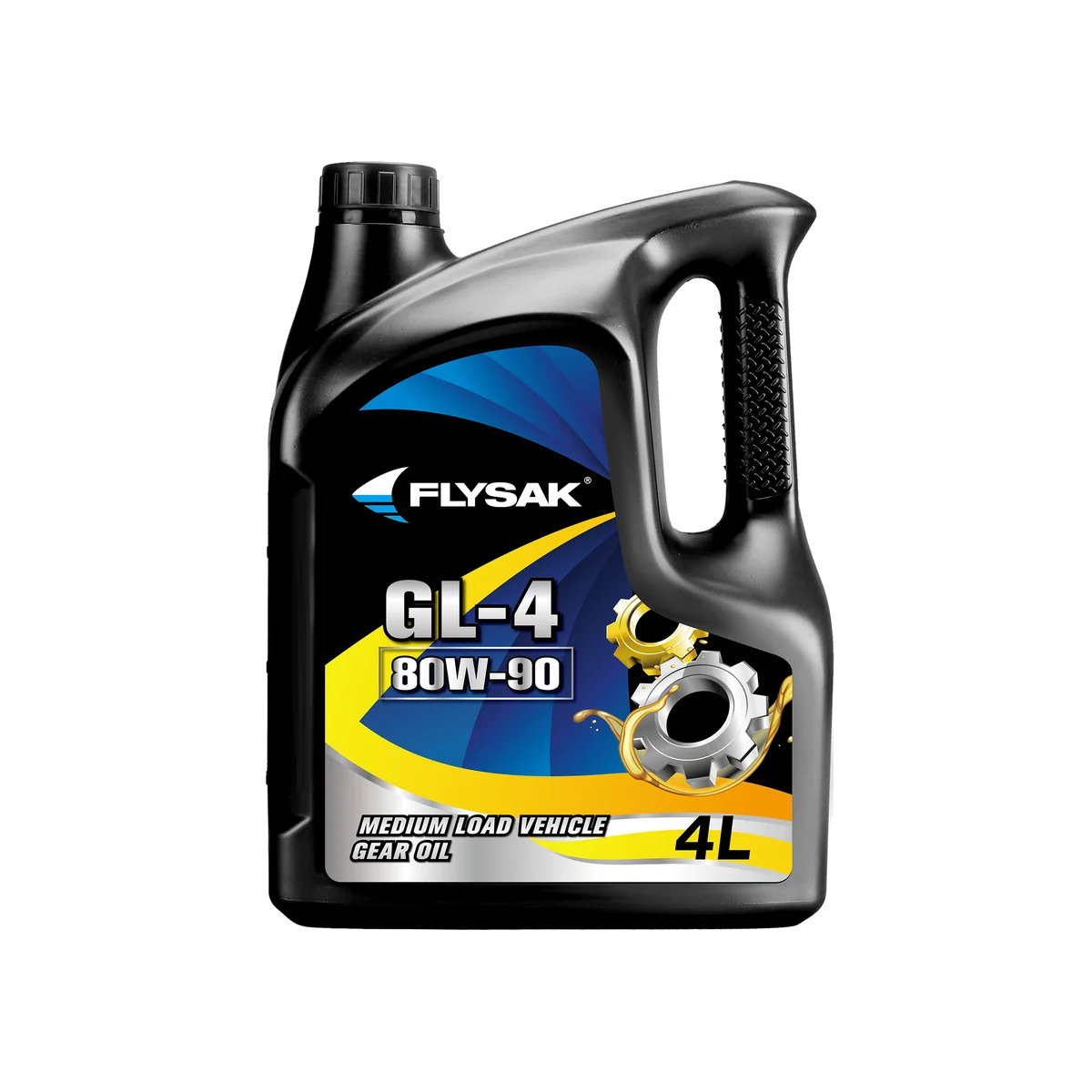
- Review the FLYSAK GL-4 SAE 80W-90 product — See the current product profile, pictured pack options and document request path.
Treat SAE viscosity as a separate selection point
SAE J306 classifies automotive driveline lubricants by rheological limits. The current SAE page explicitly notes that other lubricant characteristics are not considered. In purchasing terms, SAE 75W-90, 80W-90, 85W-90 and 85W-140 identify viscosity behaviour; they do not by themselves establish GL performance, synchronizer suitability, limited-slip performance or an OEM approval.
Use the exact grade in the vehicle or equipment requirement. Climate and duty cycle may help explain why a manufacturer offers alternatives, but they should not be used to rewrite the service instruction. Ask the supplier to show the measured viscosity properties in the current TDS and sample COA and to identify the test methods used. Compare typical values as supporting data, not as proof of every driveline application.
When an RFQ covers several grades, keep the formulation and evidence package traceable to each commercial product. Similar bottle artwork can hide different service profiles, and a shared family TDS may not tell the buyer which formulation will actually be filled.
- Compare FLYSAK gear oil products — Review the current GL-4 and GL-5 product range by stated viscosity and pack reference.
- Review the FLYSAK GL-4 SAE 85W-90 product — Compare another current manual-gearbox product profile.
Use OEM lubricant lists as application evidence, not decoration
OEM and component-maker lubricant lists can be more specific than a broad API category. ZF, for example, maintains separate TE-ML lists for different units: TE-ML 01 covers specified manual truck transmissions, while TE-ML 11 covers particular passenger-car transmissions across several designs. The published lists identify the equipment scope and product entries, and current editions replace earlier ones.
For a buyer, the lesson is procedural. Ask which exact list, edition, unit family and product name support a claim. A statement that a product meets a ZF requirement is not equivalent to the product appearing under its commercial name on a current approval list. If the supplier provides a test report, approval letter or formulation cross-reference, record what it proves and when it must be rechecked.
Artwork should use only the wording supported by current evidence and destination-market rules. Do not add manufacturer logos or approval language merely because a similar viscosity appears in an OEM list. Recheck time-sensitive lists before every major artwork revision and before relying on them in a distributor tender.
Request a document pack that traces to the shipped product
The technical document pack should connect one commercial product name and formulation identifier to its TDS, SDS, performance evidence, written specification, sample COA and label. A generic certificate or an unrelated product report may be useful background, but it does not prove that the fluid in the approved bottle is the one reviewed for the claim.
The TDS should state the viscosity grade, intended application, supported service descriptions, representative properties and limitations. The SDS supports handling and transport decisions. The COA records agreed release checks for a particular batch; it does not replace the performance work used to support a GL or OEM statement. Keep those functions separate during supplier comparison.
| Review point | Evidence to request | Buyer control |
|---|---|---|
| Application coverage | Vehicle or unit matrix tied to current service information | Approve only confirmed applications and exclusions |
| SAE viscosity | Current TDS and representative test data | Match the required grade separately from performance |
| GL or OEM statement | Claim basis, test history or current approval-list evidence | Use only supportable wording on labels and catalogues |
| Batch release | Written specification and sample COA | Agree routine tests, limits and release authority |
| Private-label pack | Filled sample, artwork proof, batch code and carton details | Approve the physical pack before mass production |
| Later changes | Written notification and reapproval procedure | Protect claims, registrations and distributor communication |
Compare packaging and order structure on the same basis
A supplier quotation is meaningful only when the product, pack and commercial assumptions match. Compare the same formulation, fill volume, bottle, cap, induction seal, label material, carton, pallet arrangement, trade term and document scope. A lower price per litre may be offset by a different bottle specification, unused printed packaging or an order mix that does not fit the launch plan.
FLYSAK's current gear-oil catalogue shows multiple pack references across selected products, including small retail packs and larger workshop or bulk formats. Availability for a private-label programme should be confirmed against the exact product and artwork scope. Do not publish an MOQ, lead time or loading quantity until the supplier has confirmed it for that combination.
Approve a production-representative filled sample rather than only a digital label. Check bottle colour, resin, closure, seal, label position, print durability, batch coding and carton marking. If several viscosities share a visual system, make the grade and application differences difficult to confuse in a workshop or warehouse.
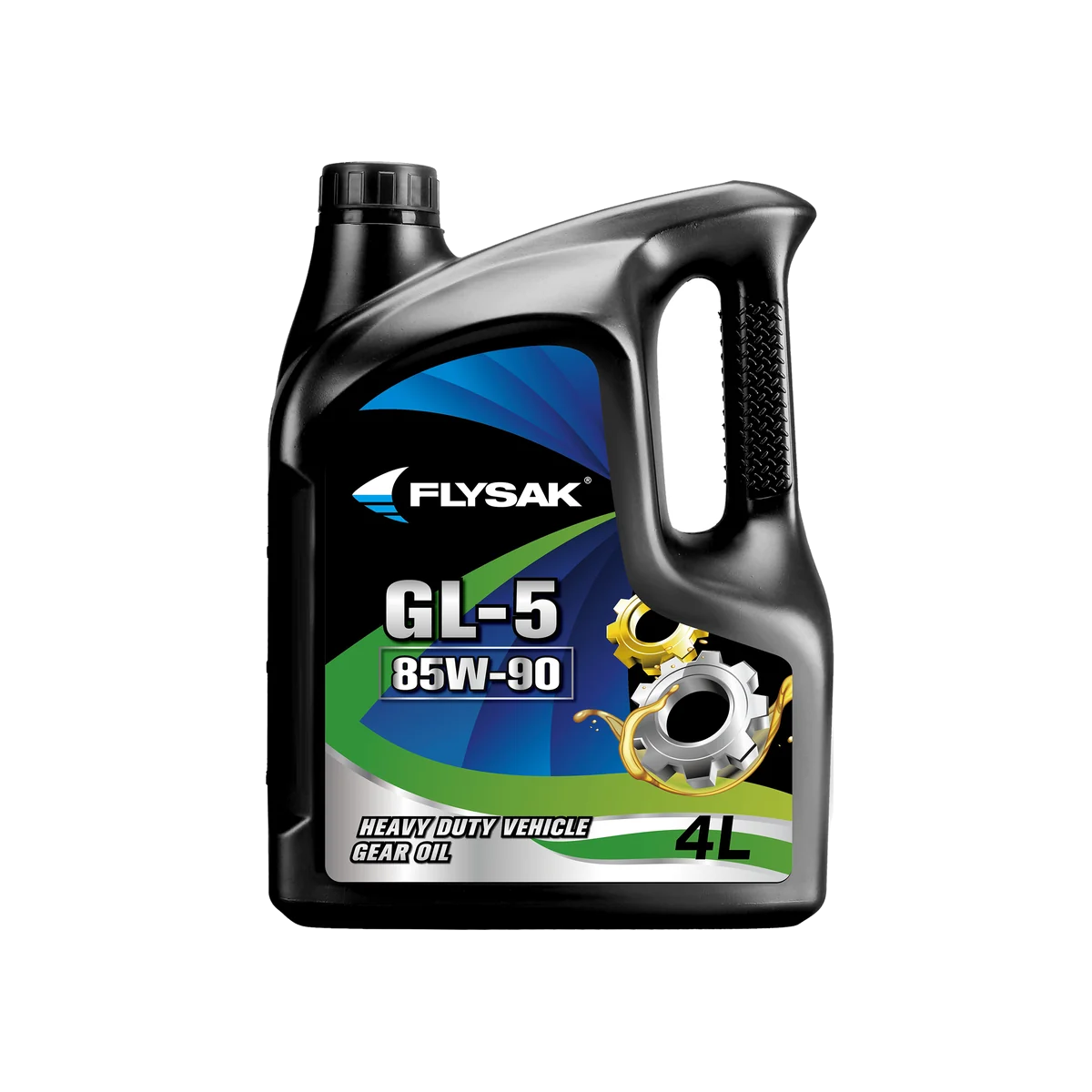
- Review the FLYSAK GL-5 SAE 85W-90 product — See a current axle and final-drive product profile and available pack references.
Control samples, batches and formulation changes
Before the first order, agree a written product specification and approve representative fluid and packaging samples. The production control plan should cover raw-material identification, formulation issue, blending records, in-process checks, filling controls, batch coding, retained samples and final release. The importer should know which values are checked on every batch and which performance evidence belongs to the approved formulation.
Define change control in writing. Changes in additive package, base oil, viscosity modifier, dye, formulation code, test method, bottle resin, closure, label stock or approval status can affect the evidence pack, artwork or market registration. Agree which changes need advance notice, updated documents, a fresh sample or written buyer approval.
A simple annual review is also useful. Vehicle coverage, OEM lists, standard editions and product documents can change even when the commercial name stays the same. Assign responsibility for reviewing those sources and correcting catalogues or distributor materials when an application is withdrawn or clarified.
Send an RFQ that exposes application gaps early
A strong RFQ includes destination countries, important vehicle or equipment families, transmission and axle codes, required SAE grades and service descriptions, pack sizes, label languages, sales channels, annual estimates and first-order mix. Attach current product labels if you are switching suppliers and identify any gearbox applications that regularly create customer questions.
Ask the supplier to return a proposed SKU map, evidence list, unsupported applications, sample plan, packaging options, batch-release approach and change-control terms. This makes gaps visible before price negotiation and prevents an attractive quotation from becoming an application problem after the product reaches workshops.
FLYSAK can review a buyer's manual-transmission and axle range against its current gear-oil catalogue and organise a private-label proposal around confirmed products and packaging. Every application and claim should still be checked against current documents before ordering or printing artwork.
- Review FLYSAK private-label support — See how product, packaging and buyer-document decisions are organised.
- Read the automatic transmission fluid supplier guide — Keep ATF, CVT, DCT and manual-gear sourcing decisions separate.
- Send your gear-oil sourcing brief — Share the application matrix, grades, pack sizes and proposed order mix.
Frequently asked questions
Is GL-5 better than GL-4 for a manual transmission?
Not as a general rule. GL-4 and GL-5 describe different service conditions, not a simple quality ranking. Use the category, viscosity and OEM requirement specified for the exact transmission. A GL-5 axle oil should not be assumed suitable for a synchronized gearbox calling for GL-4.
Can GL-5 gear oil replace GL-4?
Only when the vehicle or equipment manufacturer explicitly permits it and the proposed product supports that application. Do not treat the higher number as automatic backward compatibility. Record the manufacturer source and any conditions in the vehicle coverage matrix.
What SAE grade should an importer choose for manual transmission oil?
Choose the SAE J306 viscosity grade specified by the vehicle or equipment manufacturer for the exact unit and market. The SAE grade describes viscosity behaviour; it does not by itself establish GL performance, synchronizer suitability or an OEM approval.
What does API MT-1 mean?
API 1560 describes MT-1 for certain nonsynchronized manual transmissions used in buses and heavy-duty trucks. It does not address synchronized passenger-car transmissions and transaxles, so it should be treated as a separate equipment-specific requirement.
Which documents should a manual transmission oil importer request?
Request a current TDS, SDS, written product specification, GL or OEM claim basis, vehicle or unit coverage matrix, representative test data, sample COA, finished-pack proof and change-control procedure. All records should trace to the exact proposed formulation and commercial product.
How should private-label gear-oil quotations be compared?
Compare the same formulation, viscosity, claim evidence, fill volume, bottle, closure, seal, label, carton, pallet plan, order mix, trade term and document scope. Confirm packaging minimums and lead time for the exact SKU mix instead of assuming one figure applies to every grade.
Does a TDS prove that a product has an OEM approval?
No. A TDS can describe intended use and claims, but a formal approval should be verified against the current OEM or component-maker source and the exact commercial product name. Record whether the evidence is an approval, a tested claim or an application recommendation.
Sources
Technical and regulatory references reviewed for this article:
- API Publication 1560, Lubricant Service Designations for Automotive Manual Transmissions, Manual Transaxles, and Axles — Reviewed for GL-4, GL-5 and MT-1 service descriptions, current-use status and selection cautions.
- SAE J306_202502 Automotive Driveline Lubricant Viscosity Classification — Reviewed for the current scope and limits of driveline viscosity classification.
- ZF Aftermarket Lubricants and Lists of Lubricants — Reviewed for the current list structure and the separation of transmission families by TE-ML list.
- ZF TE-ML 01 List of Lubricants, edition 01.07.2026 — Reviewed for unit-specific manual-transmission scope, product listings and edition control.
- ZF TE-ML 11 List of Lubricants, edition 01.07.2026 — Reviewed for passenger-car transmission families and the need to verify the exact unit and current list.